Friday, January 1, 2021

Happy New Year of Ox 2021

If you are in Japan during the year-end and New Year holidays, you can see many pretty sweets at Japanese confectionary stores. As 2021 is the year of Ox according to the Chinese zodiac, we ate buns filled with sweet bean paste like these today. In most cases, such buns (called manju) are vegan, however, yellowish buns may contain egg as the one on the right. They represented oxen but looked like pigs. I just wanted to upload the picture because they were cute anyway. Happy New Year!


The design of the wrapping paper was also nice and suitable for a New Year's gift.


Sunday, December 13, 2020

Swedish almond ginger cookies

Two years ago, I introduced Swedish ginger cookies in this blog. On December 13, Swedish people have Luciadagen or Saint Lucy’s Day. Since I have lived in Finland and Sweden before, I often remember their Christmas season and traditional foods like ginger cookies at this time of year. Today I went to Entetsu Department Store and bought ANNAS Original ALMOND THINS. Like the plain ginger cookies I wrote about two years ago, they are also vegan. Though they are supposed to have an almond flavor, I could hardly feel it. I noticed a strong flavor of cinnamon instead and felt like dipping the cookies into Swedish strong coffee (as I’m sensitive to caffeine, I don’t usually drink coffee). They were so tasty and reminded me of the atmosphere of the Christmas season in Northern Europe.

In 1988, I got a ginger cookie from a girl dressed up as Lucia at a youth hostel in Stockholm on Luciadagen. It was my first trip to Sweden, and I had a wonderful time in Stockholm. But now I’m in Japan and worried about Covid-19 there. Sweden is one of several countries where use of a mask is not obligatory/recommended in public areas and the majority of people don’t wear it even now. As I’m Japanese and have used a mask all the time during this pandemic, I feel very uneasy to see news from Sweden that shows people in crowd. Last April, I sent an e-mail to a local station of SVT (Sveriges Television) to tell about mask usage in Japan. I guess some readers of this blog live in Sweden. I’ll paste the e-mail below though my Swedish is not good and may sound childish. I really want to say that wearing a mask works. Take care! 

Hej!

Jag är japanska och tittar på Norrbottens nyheter om coronaviruset på nätet. Jag har haft väninnor i svensk och finsk Lapland och känner ängslig. Det var tråkigt att det finns många som har drabbats av viruset.

I Japan och andra östasiatiska länder är det vanlingt att bära munskydd när man gå ut och rör sig bland folk. Man gör så för att inte sprida smitta även om man inte har någon symptom eller inte är smittad. Wolfgang Hanson har skrivit en bra artikel om det på Aftonbladet.

https://www.aftonbladet.se/nyheter/kolumnister/a/9v4bvd/nar-blir-det-tvang-pa-munskydd-i-sverige

Förra veckan tittade jag presskonferens och blev orolig när jag såg att det fanns ingen som hade munskydd på sig. När jag bodde i Sverige och var ute utan mössa mitt på vintern, mina kompisar blev så oroliga att de tog mig till en affär och tvang mig att köpa en. Jag tyckte de överdrev och betedde sig konstigt, men nu förstår jag hur de kände då. Nu är jag lika orolig för svenskar utan munskydd. Kanske är det min största kulturkrock. Vår premiärminister sa att de skulle skicka två tyg munskydd till varje hushåll. Men många japaner har redan sytt dem själv genom att titta på youtube eller annat på nätet.

Jag hoppas coronaviruset ska lugna ner sig snart i hela världen. Tack för informativa nyheter och sköt om er!

Många hälsningar 

Hiroko

Wednesday, September 16, 2020

Vegan emergency food in Yamada Denki

Last week, my PC didn’t work well, and I had difficulty entering characters. I wondered whether it was the PC or keyboard that had a trouble. I went to Yamada Denki, a chain of consumer electronics stores, where I bought the PC four years ago.


Like Bic Camera, another chain of consumer electronics stores, Yamada Denki sells some other things such as food, drink, and convenience goods, in addition to consumer electronics. On that day, they even had emergency food that were sold at a discount. I bought two items that seemed to be vegan. One of them is Gomoku Gohan that literally means rice with five ingredients.


Usually, such a rice dish contains chicken. But this one doesn’t contain any animal ingredients according to the description on the backside. The five ingredients added to the rice are dried carrot, deep-fried tofu, dried burdock, dried shiitake mushroom, and konjac. They are flavored with plant oil, soy sauce, and sugar. The package also has a table of 27 allergens specified in the Food Labeling Act in Japan.


*えび (shrimp), かに (crab), 小麦 (wheat), そば (buckwheat)
 卵 (egg), 乳成分 (milk), 落花生 (peanut), あわび (abalone)
いか (squid), いくら (salmon roe), オレンジ (orange), カシューナッツ (cashew nut)
キウイ (kiwifruit), 牛肉 (beef), くるみ (walnut), ごま (sesame)
さけ (salmon), さば (mackerel), 大豆 (soybean), 鶏肉 (chicken)
バナナ (banana), 豚肉 (pork), まつたけ (matsutake mushroom), もも (peach)
やまいも (yam), りんご (apple), ゼラチン (gelatin)

The words 小麦 (wheat) and 大豆 (soybean) are highlighted, which means that this product contains these ingredients.

It is very easy to prepare this Gomoku Gohan. First, I took the spoon and the oxygen absorber out of the package.


Then I poured 160 ml hot water into it, closed it, and waited for 15 minutes. As it is a kind of emergency food, you can eat it directly from the package. But I wanted to see how it look like on a dish.


It tasted light and seemed to be suitable for everyone expect those allergic to wheat and soybeans. I think I’ll buy some more while they are sold at a discount.
The other vegan item from Yamada Denki is Rice Cookies. They are made from rice powder, rice oil, sugar, sweetened coconut puree, almond flour, fermented seasoning (rice, salt), shredded coconut. Any of the 27 allergens isn’t contained in them.


The rice powder is from Niigata Prefecture that is famous as a major cultivation area of rice.


The cookies looked delicious.


One of them was broken. They seemed to be fragile but were crispy and tasty. I thought the texture was very much like that of langue de chat, French thin cookies.

Both Gomoku Gohan and Rice Cookies are the products of Onisi (尾西). I heard this company’s name for the first time, but I appreciate their efforts to provide such food. Though it is not clearly described that they are vegan, they are vegan-friendly products. In addition, both of them bear the Halal mark.


As I wrote before, it has been very difficult to find vegan food in Japan. But it seems that more and more companies have come to release vegan-friendly products recently. I think I’ll stop writing this blog now. Thank you for reading.

My blog is mainly intended for visitors or inhabitants from abroad, but in fact I myself like traveling and wish to visit some countries after corona. So, I intend to study hard in my free time to improve my language skills from now on. I wish you’ll enjoy your stay in Japan. Thank you again!

Sunday, September 6, 2020

Fruit without flower

Yesterday, I got some fresh figs that my mother bought at a local farmers’ market.


Though it seemed possible to peel the fruits by hand, I used a knife not to deform them too much. They were so soft. In Japanese, figs are called “ichijiku”. It is sometimes written as 無花果 that means a fruit without flower. I wondered where this mysterious name came from and checked some websites. Then I learned that fig trees never have flowers that look like flowers. To my surprise, the flowers are the grain-like things in the red parts of the fruits! They looked delicious.


The taste is difficult to explain. They had a gentle sweetness, but their soft texture and a grainy texture in the red part were more impressive. I remembered that dried figs in some bread also had the same grainy texture though they were much sweeter and very different from fresh ones.

I’m not sure if I like fresh figs or not because I'm more used to eat dried ones. I have had an image that figs are good for beauty. According to some websites, they are called “fruits for eternal youth.” They have polyphenols to make the skin beautiful and potassium to prevent swelling. They also improve intestinal condition. As its season continues to October, I may have more opportunities to eat them.

Monday, August 31, 2020

Long-selling adzuki bean popsicle

In this blog, I have introduced many sweets containing adzuki bean paste. You may have got tired of it, but adzuki bean paste is inevitable for traditional Japanese sweets. In supermarkets and convenience stores, you can also find popsicles whose major ingredient is adzuki bean paste. The other day, I found one sold for a reasonable price (about 50 yen) at a drug store.


The manufacturer of this popsicle "Adzuki Bar (あずきバー)" is Imuraya (井村屋) that was originally a Japanese-style confectionary store started in 1896. In 1973, they released the adzuki bean popsicle. According to their website, its price was 30 yen at that time while most popsicles usually cost only 10 yen. From the very beginning, it was intended for adults. Since my childhood, I have had an image that this kind of popsicle with adzuki beans is mainly eaten by elderly people like my grandparents. So, I have seldom eaten one myself.

This time I bought it just because the price was reasonable, but I found it may be healthier compared with other popsicles and ice creams. The ingredients were only five: sugar, adzuki beans, starch syrup, corn starch, and salt. The popsicle looked like this.


I found it moderately sweet and mild. It wasn’t too hard or too soft and had a sophisticated flavor. I even thought it was more delicious than some traditional Japanese sweets containing adzuki bean paste. With a long history as a Japanese-style confectionary store, Imuraya developed such an excellent product. It surely was a popsicle for adults.

Sunday, August 30, 2020

Chilled Chinese noodles with vegan toppings

Ramen is a popular dish in Japan all year round. In summer, we have seasonal ramen “Hiyashi Chuka (冷やし中華)” that literally means “chilled Chinese”. It is a cold dish made with ramen noodles and various toppings. I had thought for a long time that it had come from China, but actually it was invented in Japan.

You can eat Hiyashi Chuka in ramen shops at this time of year, but instant products are also available in supermarkets. Like other ramen products, they usually have soup made from dried bonito broth in the package, so I had never bought one until recently. But Last Sunday, when I was in Mori-machi with my mother, I happened to find a product that seemed to be vegan.


The picture on the packages shows popular toppings for Hiyashi Chuka such as cucumber, tomato, ham, omelet cut into strips, prawns, and okra. The first four toppings are very common both in restaurants and at home. The package contained noodles and soup for two portions. The soup was made from brewed vinegar, salt, plant oil, soy sauce, seasonings (amino acid, etc.), acidifier, and caramel coloring.


For topping, I used another instant food “Seaweed & Konjac Salad” instead of omelet and ham.


To make this salad, you only need to soak seaweed in water for ten minutes and drain, rinse konjaku, and sprinkle your favorite dressing on them. I used half of them for the toppings of Hiyashi Chuka.


The noodles were also easy to prepare. It took only five minutes to boil them. After that I cooled the noodles with running water. In addition to the soup, seaweed, konjac, I also added sliced tomato and cucumber strips.


Konjac is jelly made from konjac yam roots. To my mind, it is almost tasteless, but it is said to be good for diet as it is rich in dietary fiber.


The combination of cold noodles and soup containing vinegar was very good. It was refreshing and stimulated my appetite. I also added some sesame oil, which made the noodles more delicious.


Saturday, August 22, 2020

Growing avocado in water

Today I visited my parents’ house, and my mother showed me some pictures she had took recently. One of them was a picture of avocado on the windowsill in the kitchen. At the beginning of this year, she started water cultivation with the seed of an avocado that she had eaten.

On the windowsill, there were two avocado seed. This one is older and cracked. It was put in a coffee cup from a convenience store.


In addition to the cup, a garbage draining tool was used to support the seed. My mother said it had taken a long time to sprout. When she gave up and was about to discard the seed, she noticed that the roots had come out first.


Now it has also three leaves.


The stem is quite long. It is about 32 cm from the seed to the top of the stem.


The other seed on the windowsill hasn’t sprouted yet though water cultivation was started on July 5.


I wondered how in the world she had thought of cultivating avocado as I had never imagined that it could grow in Japan. Most avocados sold in Japan are imported from Mexico. My mother said that it was her acupuncture therapist who had told her about it. I also wondered if it was necessary to plant it in soil when it would further grow. How tall will it be?

According to some websites, there are some places in Japan where farmers cultivate avocados. Among them, Matsuyama in Ehime prefecture aims to be No.1 in avocado cultivation in Japan. Their avocados were first released in the market in the city of Matsuyama in 2016. I have never seen avocados from Matsuyama or any other places in Japan, but I would like to buy their fruits if they become available in ordinary supermarkets here. Domestic avocados are said to have a richer taste as they can stay longer on trees compared with imported ones.

Monday, August 17, 2020

Mein Schloss - Craft brewery & Beer hall restaurant

As I wrote before in this blog, I can’t drink alcohol. On the contrary, my sister loves drinking and has never got drunken. Since she will soon hit the big ?-oh, I wanted to send something special for her birthday. So, I went to Mein Schloss (My Castle) near JR Hamamatsu Station.


Mein Schloss is a beer hall restaurant with a brewery and a courtyard. I have once had a pizza that was like Pizza Margherita in the restaurant. The interior and atmosphere were very much like those in German beer halls I had seen on TV and more impressive than the pizza itself. Other people were eating sausages that also looked very German. You can feel as if you were in Germany. Under this corona period, the restaurant seems to take more strict measures than other places in Hamamatsu. They take customers’ temperatures and request customers to wear a mask when they walk around in the building.


This time, I just visited their shop on the left to buy the present. Behind the counter, there was a series of beer. I chose a set of four types of beer Schwarz, Alt, Helles, and Weisen. They were made in the brewery of Mein Schloss and labeled as “HAMAMATSU BEER.” According to the website, their products are made according to German Reinheitsgebot (purity order). This law was originally established by Wilhelm IV in Bavaria in 1516 and limited the ingredients of beer to just water, barley, and hops (yeast was added later). It is interesting to know that all these different types of beer are made from the same simple ingredients.


The shop of Mein Schloss has also some food from abroad such as pickles, cookies and gummi candies and souvenirs of Hamamatsu. I bought bottles of cucumber pickles and olives home.


In addition, I found some beautiful Christmas ornaments from Germany. It was funny to see snowmen in the middle of summer.


These wooden ornaments somehow reminded me of German bread Brezel. You can eat one in the restaurant.


In the Christmas season, the courtyard will have gorgeous illumination at night. Even in summer, it was nice to see with parasols and flowers.


Now it is almost impossible to go overseas because of covid-19. But even if you are in Hamamatsu, you can see something German in Mein Schloss, and there is also Hamamatsu Museum of Musical Instruments that presents musical instruments from all over the world. It is just a few minutes walk from Mein Schloss.


Yesterday, my sister sent me a mail to inform that she received the beer. She said she would have it for dinner with steak and tortilla chips. I wished I could drink beer because tortilla chips surely go well with beer and the temperature was 40 degrees here, which I had never experienced before.

Mein Schloss
Address:  8-1 Chuo 3-chome, Naka-ku, Hamamatsu-shi, Shizuoka
Tel: 053-452-1146
Opening hours: Weekdays 11:00 - 14:30, 17:00 - 23:00
                       Saturday 11:00 - 23:00
                       Sunday and holidays 11:00 - 22:00
Closed: Monday, December 31 and January 1
Access: 8-minute walk from JR Hamamatsu Station

Sunday, August 16, 2020

Spicy vegan Thai curry

Like Chinese dishes, curry is one of the most popular dishes in Japan. There are a variety of retort pouch curry available in supermarkets. In larger supermarkets and import food stores, you can even find some Indian and Thai curry in addition to Japanese-style curry. Though I have introduced Indian curry such as Chana Masala in this blog, I had never eaten Thai curry until recently. I once thought that Thai green curry was a kind of vegetarian curry. So, I was very disappointed to find “chicken” among its ingredients. There are some Thai restaurants in Hamamatsu, but I have never visited them because it seems to difficult to find substantial vegetarian/vegan dishes.

The day before yesterday, I wrote about the vegan retort sauce of Mapo Doufu released by KaRuNa in April. At the same time, they also released “Vege Spicy Thai Curry.” Luckily, I found it in the same store BIO Atsumi and could finally taste Thai curry. The package resembled that of the Mapo sauce.


It was easier to prepare than Mapo Doufu as you only need to warm up the pouch in boiling water for 5 minutes and pour into a dish. At first, I was a little disappointed as I could see only a chunk of soy protein.


But it also contained some big pieces of bamboo shoot.


This was my first time in my life to eat Thai curry, and I thought it was very interesting that curry could contain bamboo shoot. I had never eaten such curry before. In addition to bamboo shoot, it contained soy protein chunks, mushroom, celery and was flavored with coconut milk, canola oil, soy sauce, spices, salt, curry powder, etc. Even though it contained coconut milk that might have added a mild flavor, the curry was quite spicy, but not as spicy as Mapo Doufu I ate previously. While eating, I somehow remembered curry soup with cabbage served in elementary school lunch. Though I liked the school lunch, this Thai curry was much tastier with coconut milk, bamboo shoot, and soy protein chunks. Celery was also good to have in soup.

KaRuNa’s “Instant Vegan” series have just two products “Vege Mapo Sauce” and “Vege Spicy Thai Curry”. I hope they will expand the lineup so that we can increasingly enjoy vegan versions of popular Asian dishes at home.

Friday, August 14, 2020

Mapo Doufu with vegan sauce

As in other countries, Chinese cuisine is very popular in Japan. According to a popularity vote, the most popular Chinese dish in Japan is Mapo Doufu (麻婆豆腐) originated from Sichuan province. It consists of tofu and minced meat cooked with spicy sauce. In supermarkets, you can see some retort sauce for Mapo Doufu and other Chinese dishes, but basically, they are not for vegetarians/vegans.

The other day, I went to BIO Atsumi to see if there were any new products of vegan curry. BIO Atsumi is a supermarket chain in eastern Aichi Prefecture (with one store in Hamamatsu) and has many rare and interesting foods from both Japan and abroad. There I found “Vege Mapo Sauce”, which was a pleasant surprise.


Though Mapo Doufu is a popular dish, I had hardly had a chance to eat it before because of the ingredients. Instead of minced meat, this product uses granular soy protein. The sauce is flavored with sesame oil, grated ginger, douchi or fermented black beans, doubanjiang or broad bean chili paste, soy sauce, chili oil, sugar, kelp powder, spice, etc.

Mapo Doufu is very easy to prepare with this retort sauce. You only have to pour and warm up the sauce in a pan, mix tofu cut into cubes, and cook together for a few minutes by stirring sometimes. One retort pouch is intended to be used for 300 g of tofu. As this pack of tofu was 400 g, I used one half or 200g of it.


Ten minutes later, Mapo Doufu was ready.


I think this was my second or third time to eat Mapo Doufu in my life. As soon as I started eating it, I noticed that it was more spicy than other spicy foods I had eaten before, such as Indian chickpea curry Chana Masala and Korean Shin Ramen. I suddenly remembered cold water kimchi in the refrigerator and took it out. It is seasonal animal-free kimchi sold in Seijo Ishii, which I wrote about in this blog last year. It consists of ten ingredients and is delicious and refreshing. As I expected, it mitigated the spiciness of Mapo Doufu.


One of the major reasons why Mapo Doufu is loved in Japan is that it goes well with rice and stimulate the appetite. I found it true as I could eat two bowls of rice with it. Though the sauce was unexpectedly spicy, the granular soy protein was well-made and didn’t have a distinctive flavor of soybeans at all. It may be easy to eat even for non-vegetarians.

The manufacture of this sauce is a Nagoya-based vegetarian food company KaRuNa. It has two shops (Nagoya and Komatsu in Ishikawa Prefecture), but I think it is mostly known for its online shop that provides a wide variety of vegetarian/vegan food (unfortunately the website is available only in Japanese). The name KaRuNa comes from an old Indian word that means compassion.


“Vege Mapo Sauce” is one of their “Instant Vegan” products released in April 2020. I think I’ll introduce the other one next time.

Wednesday, August 12, 2020

Hamamatsu Reconstruction Memorial

August is the month when Japanese people recall the experiences of World War II. Due to the militarism that arose in the Meiji Period (1868-1912), Japan started to invade neighboring countries already in the second half of 19th century. It colonized Taiwan and Korea, established a puppet state Manchuria in China, and started a war with China (Sino-Japanese War). To get natural resources, invasion to Southeast Asia was also started, and the Pacific War with the Allies broke out in 1941. The war ended in August 15, 1945, after atomic bombs were dropped in Hiroshima and Nagasaki. Every year, a siren is blown all over Japan on August 6 and 9, exactly at the same time when the bombs were dropped. Then we pray for the souls of the victims of the bombs. On August 15, we hear a siren at noon and remember the end of the war.

Even before the atomic bomb attacks, many cities were bombed and destroyed during the Pacific War. A Japanese animation film “Graves of the Fireflies (火垂るの墓 (hotaru-no-haka))” depicts the air raid in Kobe. Though Hamamatsu was a relatively small city with a population of 187,433 (as of 1944), it had 27 air raids in total. It was partly because Hamamatsu is located between big cities such as Tokyo and Osaka, and American bombers dropped the remaining bombs here to dispose of them after attacking these cities. Another reason is that Hamamatsu is an industrial city and had many factories producing weapons. For example, the factory of Yamaha, a musical instrument company, made propellers of aircrafts at that time. By the end of the war, more than 3,500 citizens were killed, and most of the city was destroyed. In Hamamatsu Castle Park, there is a memorial of it.


In a quiet area near the downtown, there is a small museum called Hamamatsu Reconstruction Memorial to present the life under the war and the reconstruction after that. In summer, many groups of local school children visit there with their teachers. But this year, the museum has much less visitors because of covid-19. As it has been 75 years since the end of the war and I live near the museum, I visited there to remember the history of the war today.


The exhibition is started with a big panel with pictures of the destroyed downtown. I think this picture is the most familiar to people in Hamamatsu as it is used in many materials describing the history of the city.


These are fragments of bombs.


Incendiary bombs are also displayed with description of the mechanism.


In the next room, you can see people’s daily life under the war. At that time, men wore a national uniform that resembled the military uniform. On the left of the uniform, there were an air-raid hood and helmet to protect the head from air raids.


Women usually wore work pants and regularly participated in a fire drill with bucket brigade training. With the Anti-Aircraft Defense Law, the Japanese government obliged ordinary people to extinguish fire caused by air raids and prohibited them from running away. This increased the number of victims of air raids.


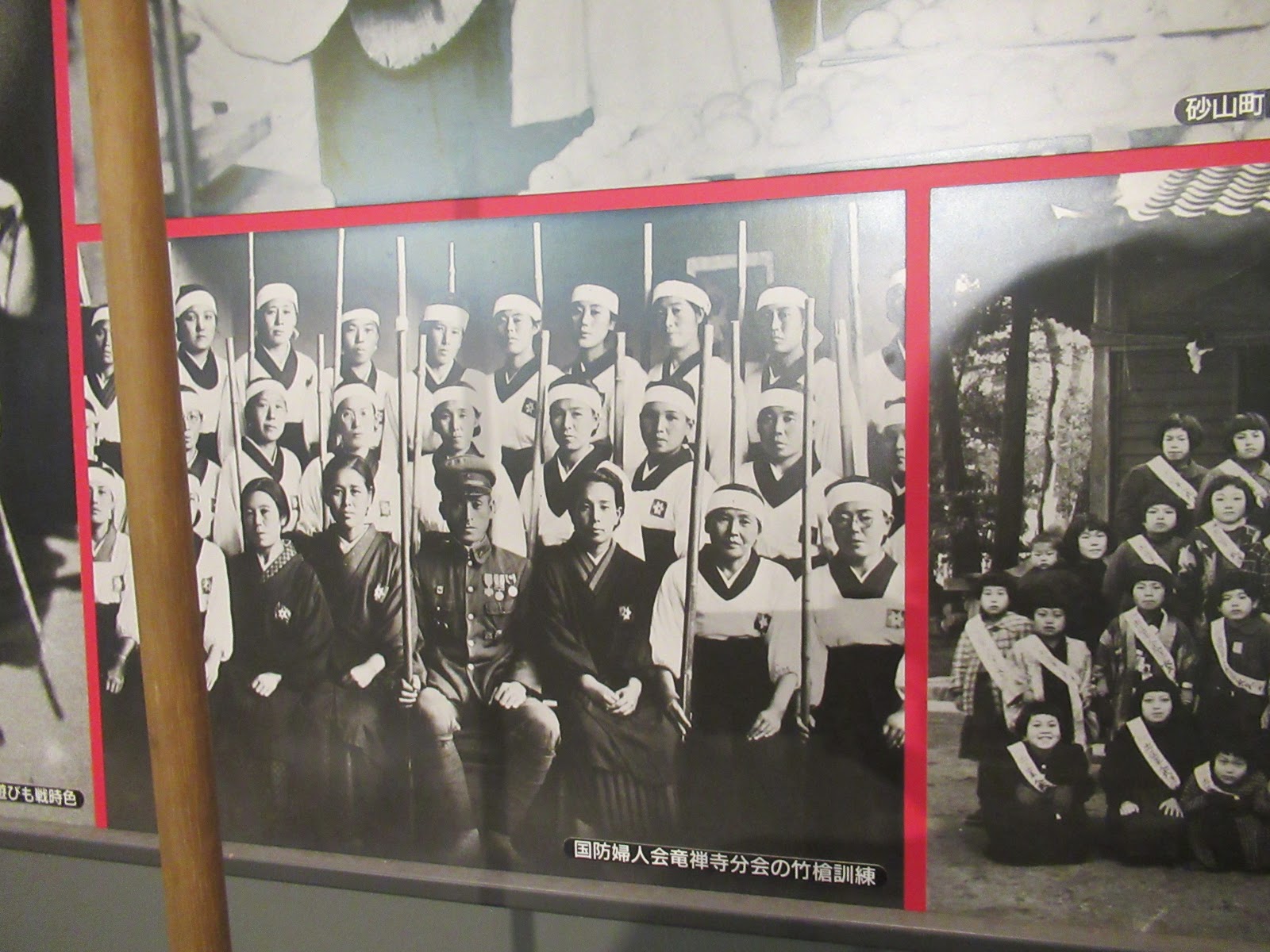
In addition to a fire drill, women were trained to fight against enemies with bamboo spears in case they would land in Japan.


Even children played at soldiers.


These pictures convey such an unusual atmosphere or madness during the war. For me, the most shocking exhibit in the museum was a diary written by a 15-year-old student who was mobilized and worked at a factory to support the production of weapons. Her wording and handwriting were like those of an adult. I suppose she was a hardworking and intelligent girl and might be a kind of roll model for other students at that time. In the last part, she emphasized that they should increase the production of weapons to reward the efforts of soldiers. The day after she wrote this, she was killed in an air raid to the factory.


It has been 75 years since the end of the Pacific War. I think we should remember not only how the life was during the war but also how the war occurred. Many years ago, I read a series of comic books “Barefoot Gen (はだしのゲン (hadashi-no-gen))” in this museum. It was drawn by Keiji Nakazawa, a survivor of the atomic bomb in Hiroshima. He depicts the daily life of Hiroshima during the wartime based on his childhood memories. In this work, the father of the main character Gen is against the war and says to his children: “Don’t be deceived, children. You should get along with all the people in Korea and China. It is the only way to prevent a war.” I think this message is very important, especially now.

Hamamatsu Reconstruction Memorial also exhibits everyday objects in old days.


I got interested in this classic shaved ice machine. How old is it? When I saw it, I felt like eating the soda popsicle GariGarikun. Now the temperature is around 35℃, and it will be continuously hot this week.


Hamamatsu Reconstruction Memorial
Address: 304-2, Togi-machi, Naka-ku, Hamamatsu-shi, Shizuoka
Tel: 053-455-0815
Opening hours: 9:00-17:00
Closed: Mondays (if a national holiday falls on Monday, it is closed the next day instead), December 29 - January 3, the day after a national holiday)
Access: 10-minute walk from JR Hamamatsu Station

Happy New Year of Ox 2021

If you are in Japan during the year-end and New Year holidays, you can see many pretty sweets at Japanese confectionary stores. As 2021 is t...