Yesterday, after introducing a video concerning covid-19 in this blog, I remembered another video found on YouTube. It is a documentary “LONG TIME NO SEE WUHAN (https://www.youtube.com/watch?v=N4ABOJ1y5iM)” made by a Japanese director Takeuchi Ryo (竹内亮). The title is “好久不见, 武汉” in Chinese and “お久しぶりです、武漢” in Japanese. In this video, the director had interviews with ten ordinary people in Wuhan, including a restaurant owner, nurse, junior high school teacher, etc.
Takeuchi Ryo has a good command in Chinese and talks in a friendly manner. At a company that manufactures masks, surgical gowns, and protective suites, he tried on a protective suite and said that the inside felt like a sauna house. I could also imagine how hard it was for doctors and nurses to work all day with such a suite on. On the next day, he had an interview with a nurse, Ms. Gong. Though she was a cheerful person, she had difficulty telling about the death of patients. I realized the work of medical workers is hard both physically and mentally. One interesting thing is that they can enter sightseeing spots free of charge by showing their ID. I think it is a very nice privilege. Such consideration and respect to medical workers are also necessary in other countries.
As a whole, I got an impression that the video naturally conveys the voices of people in Wuhan. Personally, I liked to hear female interviewees speaking openly and lively in Chinese (In Japan, many women extremely disguising their voices in public. Such voices are not pleasant to hear).
Among the male interviewees, I was especially impressed by the interview with Mr. Li who did the electrical and wiring work in construction of Wuhan Leishenshan Hospital, which was an exclusive hospital for covid-19 and built in only ten days (normally, it would take six months). It seemed that in China, they made every effort to fight against covid-19 and handled it in a very careful manner. According to Mr. Li, the company he belonged to provided Chinese medicine to all the workers, and he took it after meals to boost immunity. I wondered what kind of medicine it was and got interested in it. As Japanese drug stores have a corner for Chinese medicine, you may be able to find some tablets with a similar effect. Since Chinese medicine is said to have less side effects, it is sometimes used for chronic disorder even though it can be more expensive compared with western medicine. When I was little, I ate Chinese medicine for several months to cure poor blood circulation.
In “LONG TIME NO SEE WUHAN”, I could see some food and wondered if it is easy to find vegetarian/vegan restaurants or street food there. The restaurant owner Mr. Lai in the video said that people in Wuhan love to eat fish as the city is by the Yangtze River. He was a regular customer of Huanan Seafood Market but barely saw any wild animals sold there.
Showing posts with label Videos. Show all posts
Showing posts with label Videos. Show all posts
Sunday, August 2, 2020

Saturday, August 1, 2020
Salt Lychee Candy in cute package
Today, the Japan Meteorological Agency announced that the rainy season is over in the Tokai district (including Hamamatsu). It was fine and I went out to buy some foods early in the morning. It took me more than 30 minutes to get to a supermarket MaxValu, which is situated in the opposite direction to the downtown where two corona clusters broke out last week. When I returned home, I sweated a little though it was still 8:30. It has been getting hotter recently, and I saw people walking without a mask, even in the supermarket. As mask wearing is required by stores including supermarkets, customers should follow the rule. Even if mask wearing is said to increase the risk of heat stroke in summer, I don't think it occurs in stores that are cooled with air-conditioners.
Last year, I introduced salt candies that are said to prevent heat stroke. In summer, you can find several kinds of such candies in supermarkets, convenience stores, and drugstores. Today, I ate one of them for the first time this year. It was Salt Lychee Candy sold at a FamilyMart.

The package is palm-sized, and there were eight candies inside. It is convenient to carry in a bag or eat alone. The candies are vegan and contain concentrated lychee juice.
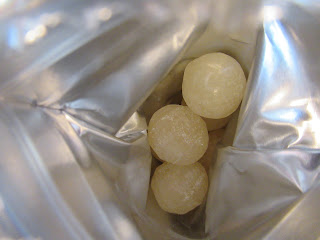
I expected that it was salty, but it wasn’t. The candies were a little sour and had an exotic flavor. As real lychees are difficult to find in Japan (at least in Hamamatsu), I have eaten them only twice before (one or two at a time) and can’t tell the difference of the flavors between the fresh fruits and candies. Anyway, I was relieved to confirm the candies don’t taste bad.
One month ago, I sent this Salt Lychee Candy and other things to my friend in Sweden. Since they had an extraordinarily high temperature in June, I was worried that it would become a hot summer. I chose this salt candy because the package was cute but never tasted it myself before.
Fortunately, it wasn’t so hot in July in Lapland where my friend lives, but Sweden has problems concerning covid-19. A few days ago, a Swedish mathematician Marcus Carlsson had a talk with Taiwan’s Digital Minister Audrey Tang and uploaded it on YouTube with the following title:
On Pandemic Management, Dynamic Democracy and How to Implement Social distancing in Intimate bars :)
(https://www.youtube.com/watch?v=dOfgquh6UPY).
Taiwan is a country that has successfully controlled covid-19 with rapid and effective measures including the mask map launched by Audrey Tang. This video was eye-opening and informative, and I was very impressed by Audrey Tang's intelligence and fluent English. I hope more and more people will access it from Sweden and other countries as well.
Last year, I introduced salt candies that are said to prevent heat stroke. In summer, you can find several kinds of such candies in supermarkets, convenience stores, and drugstores. Today, I ate one of them for the first time this year. It was Salt Lychee Candy sold at a FamilyMart.

The package is palm-sized, and there were eight candies inside. It is convenient to carry in a bag or eat alone. The candies are vegan and contain concentrated lychee juice.

I expected that it was salty, but it wasn’t. The candies were a little sour and had an exotic flavor. As real lychees are difficult to find in Japan (at least in Hamamatsu), I have eaten them only twice before (one or two at a time) and can’t tell the difference of the flavors between the fresh fruits and candies. Anyway, I was relieved to confirm the candies don’t taste bad.
One month ago, I sent this Salt Lychee Candy and other things to my friend in Sweden. Since they had an extraordinarily high temperature in June, I was worried that it would become a hot summer. I chose this salt candy because the package was cute but never tasted it myself before.
Fortunately, it wasn’t so hot in July in Lapland where my friend lives, but Sweden has problems concerning covid-19. A few days ago, a Swedish mathematician Marcus Carlsson had a talk with Taiwan’s Digital Minister Audrey Tang and uploaded it on YouTube with the following title:
On Pandemic Management, Dynamic Democracy and How to Implement Social distancing in Intimate bars :)
(https://www.youtube.com/watch?v=dOfgquh6UPY).
Taiwan is a country that has successfully controlled covid-19 with rapid and effective measures including the mask map launched by Audrey Tang. This video was eye-opening and informative, and I was very impressed by Audrey Tang's intelligence and fluent English. I hope more and more people will access it from Sweden and other countries as well.
Monday, July 6, 2020
Life in rural China introduced by Swedish vegetarian
Since the outbreak of COVID-19, I have been interested in news about China. When I was in university, I studied Finnish and Swedish. But later, I taught myself two Asian languages Chinese and Korean to keep balance. In this corona period, I often wish I could understand the Chinese language better to grasp the situation more correctly. I was shocked to see how negatively some media in Japan and abroad reported about China. To my mind, COVID-19 is a kind of natural disasters like typhoons (people don’t care about where they come from), and the government of each country should have focused on taking practical measures from the beginning to prevent further spreading instead of blaming China.
In YouTube, I have found some foreigners who live in China and tell about their experiences through their channels. They have their own words to describe the reality in China. In addition to the measures for covid 19 and other policies taken by the government, I can also learn about the lives of ordinary people, which are more interesting for me than political matters. Among such channels, I found “Miriam in China” especially heartwarming and rare.
Miriam is a young Swedish woman who is married to a Chinese man from a rural area in Qinghai. She first came to China in 2015 as an exchange student. In her channel, she has introduced their rural life, traditional annual events and foods. She is a vegetarian. It is exciting to see how she, her husband and mother-in-law cook at home. Her husband makes noodles in a skilled manner, and their moon cakes are very different from the ones I have seen before. All the dishes are vegetarian (or some of them may be vegan) and look so fresh and delicious!
Last week, she posted a video “Dragon Boat Festival in Rural Qinghai.“ This is a traditional festival held on May 5 of the lunar calendar. In this video, Miriam and her mother-in-law have mugwort behind their ears and look cute. I remember our kusamochi (rice-flour dumpling mixed with mugwort) eaten in traditional events such as Doll’s Festival. Both in China and Japan, mugwort is considered good for health and has been used as a medical herb. As a traditional food for this day, Miriam makes zongzi with sticky rice, candies dates and raisins by wrapping them with bamboo leaves. In Japan, we have a similar food called chimaki, which has become a sweet available on confectionary stores and eaten on May 5 of the solar calendar.
In “Dragon Boat Festival in Rural Qinghai“, Miriam uses “Ensam (Alone)” by Sandra Marteleur as the background music for the scene of mugwort field. It sounds like Swedish folk music but in natural harmony with the scene, like Miriam herself in the family.
“Dragon Boat Festival in Rural Qinghai“
(https://www.youtube.com/watch?v=JQfvYkaIvYg&t=195s)
In YouTube, I have found some foreigners who live in China and tell about their experiences through their channels. They have their own words to describe the reality in China. In addition to the measures for covid 19 and other policies taken by the government, I can also learn about the lives of ordinary people, which are more interesting for me than political matters. Among such channels, I found “Miriam in China” especially heartwarming and rare.
Miriam is a young Swedish woman who is married to a Chinese man from a rural area in Qinghai. She first came to China in 2015 as an exchange student. In her channel, she has introduced their rural life, traditional annual events and foods. She is a vegetarian. It is exciting to see how she, her husband and mother-in-law cook at home. Her husband makes noodles in a skilled manner, and their moon cakes are very different from the ones I have seen before. All the dishes are vegetarian (or some of them may be vegan) and look so fresh and delicious!
Last week, she posted a video “Dragon Boat Festival in Rural Qinghai.“ This is a traditional festival held on May 5 of the lunar calendar. In this video, Miriam and her mother-in-law have mugwort behind their ears and look cute. I remember our kusamochi (rice-flour dumpling mixed with mugwort) eaten in traditional events such as Doll’s Festival. Both in China and Japan, mugwort is considered good for health and has been used as a medical herb. As a traditional food for this day, Miriam makes zongzi with sticky rice, candies dates and raisins by wrapping them with bamboo leaves. In Japan, we have a similar food called chimaki, which has become a sweet available on confectionary stores and eaten on May 5 of the solar calendar.
In “Dragon Boat Festival in Rural Qinghai“, Miriam uses “Ensam (Alone)” by Sandra Marteleur as the background music for the scene of mugwort field. It sounds like Swedish folk music but in natural harmony with the scene, like Miriam herself in the family.
“Dragon Boat Festival in Rural Qinghai“
(https://www.youtube.com/watch?v=JQfvYkaIvYg&t=195s)
Wednesday, May 6, 2020
Believe in our future
Today is the last day of our holiday season called the Golden Week. Since the government declared a state of emergency for the coronavirus that covers all over Japan until May 6, we are expected to stay at home to the extent possible. Even in Hamamatsu, many restaurants have responded to the request from the city to close until May 6.
The holiday season has passed calmly. The population of Hamamatsu is about 800,000. Until now, seven people have been infected, but there has been no new case found for three weeks. Though the state of emergency has been extended until the end of May, the city doesn’t extend the period of the request for closure. The local restaurants will be opened tomorrow.
Under such circumstances, the city made a video “Believe in our future – Hamamatsu, Japan” to promote sightseeing after recovery from COVID-19. It is posted on YouTube:
https://www.youtube.com/watch?v=5eVqehSWeik
Though it is a very short video, it contains beautiful scenery of Hamamatsu Castle, Lake Hamana, etc. in spring. On YouTube, I found some other interesting videos about Hamamatsu:
SHIZUOKA 【Cherry blossoms】“Somei-Yoshino” at Hamamatsu Flower Park 2020.
https://www.youtube.com/watch?v=jKvQ3Iqke8s
【大迫力】これぞ大凧あげ! 浜松まつり 開会式の混戦を揚げきる
https://www.youtube.com/watch?v=hKMVHivXrro&t=530s
(Hamamatsu Festival with exciting kite flying)
Hamamatsu Kite Festival – Celebrating the New Born Baby - Flying Kite
https://www.youtube.com/watch?v=5RjxcFWFN1I
(Short video with a new-born baby, his parents, and neighborhood)
As I wrote yesterday, Hamamatsu Festival was canceled this year. I wish the Japanese government will learn from the success of our neighboring countries to take useful measures against COVID-19 as soon as possible so that we can have a powerful festival next year.
The holiday season has passed calmly. The population of Hamamatsu is about 800,000. Until now, seven people have been infected, but there has been no new case found for three weeks. Though the state of emergency has been extended until the end of May, the city doesn’t extend the period of the request for closure. The local restaurants will be opened tomorrow.
Under such circumstances, the city made a video “Believe in our future – Hamamatsu, Japan” to promote sightseeing after recovery from COVID-19. It is posted on YouTube:
https://www.youtube.com/watch?v=5eVqehSWeik
Though it is a very short video, it contains beautiful scenery of Hamamatsu Castle, Lake Hamana, etc. in spring. On YouTube, I found some other interesting videos about Hamamatsu:
SHIZUOKA 【Cherry blossoms】“Somei-Yoshino” at Hamamatsu Flower Park 2020.
https://www.youtube.com/watch?v=jKvQ3Iqke8s
【大迫力】これぞ大凧あげ! 浜松まつり 開会式の混戦を揚げきる
https://www.youtube.com/watch?v=hKMVHivXrro&t=530s
(Hamamatsu Festival with exciting kite flying)
Hamamatsu Kite Festival – Celebrating the New Born Baby - Flying Kite
https://www.youtube.com/watch?v=5RjxcFWFN1I
(Short video with a new-born baby, his parents, and neighborhood)
As I wrote yesterday, Hamamatsu Festival was canceled this year. I wish the Japanese government will learn from the success of our neighboring countries to take useful measures against COVID-19 as soon as possible so that we can have a powerful festival next year.
 |
| Scenery near the kite flying field |
Subscribe to:
Posts (Atom)
Happy New Year of Ox 2021
If you are in Japan during the year-end and New Year holidays, you can see many pretty sweets at Japanese confectionary stores. As 2021 is t...

-
 Several months ago, I read about vegan noodle “Shin Ramen (Shin Ramyeon/Shin Ramyun)” made by a food company Nongshim in Korea on the Intern...
 -
 In Japan, vegetarians or vegans may sometimes feel themselves unwelcome in restaurants, because it is very difficult to find substantial dis...
 -
 Tianjin sweet roasted chestnuts (天津甘栗 (tenshin-amaguri)) or sweet chestnuts (甘栗(amaguri)) are one of popular snacks in Japan. They are avail...