Showing posts with label Trips. Show all posts

Wednesday, December 4, 2019

Autumn leaves in Jakkoin, Kyoto

Last weekend, my mother and I went to Kyoto by Shinkansen. We left JR Hamamatsu Station at 7:49. The train was full of people as it was the best season to see autumn leaves. At first, we couldn’t have seats but managed to find ones when some passengers got off the train at Mikawa Anjo in Aichi Prefecture. After arriving at Kyoto at 9:37, we bought a one-day pass respectively that provides unlimited number of rides on the subway and three kinds of buses.


Kyoto have many famous spots for autumn leaves viewing. This time, we were going to Ohara that is a bit distant from the downtown. Usually it takes about 60 minutes to get there by bus, but we took the subway to Kokusai Kaikan (last station) and then the bus to Ohara. They increased the number of buses to Ohara during the autumn leaves season. We could take the bus soon and have seats. However, it took longer than usual to get to Ohara because the roads were crowded.

Bus stop in fromt of Kokusai Kaikan Station
Ohara is a mountainous rural area in Kyoto. Our main destination is Jakkoin, one of the famous temples in Ohara. On our way there, we enjoy a view of old-style houses surrounded by beautiful nature.


It was a little over 11:00, and we had lunch in Tamba Chaya. Though their lunch sets weren’t vegetarian because they used dried bonito broth for the main dishes such as buckwheat noodles, they included several kinds of local pickles. People in this area cultivate some vegetables that are a little different from those in Hamamatsu. They were growing very well.


Jakkoin is a very old temple that is said to have been built in 594. If you search with “Jakkoin Temple”, you can find some explanations of its long history, especially about Kenreimon-in who was the mother of Emperor Antoku. She became a nun after her clan Heike was destroyed in the Battle of Dan-no-ura in 1185. In this temple, she consoled the spirits of the people in the Heike clan, including her son Emperor Antoku who passed away during the battle at the age of six. Apart from the historical events, I thought Jakkoin is a temple worth visiting. My mother first visited there more than 50 years ago but still remembered the beautiful autumn leaves that covered the stairs to the temple. This time, we couldn’t have such a view, however, their garden was still impressive to see. According to the map, the building over there is a tea ceremony room.


We climbed up further to go to the main building.


From the stairs, we could see fallen leaves on the green moss on the roofs (one of them is that of the entrance of the garden).


This is the main building. The autumn leaves behind it were so beautiful. We got inside and heard about the history of the temple.


This is the Belfry of Shogyo Mujo. It is a Buddhist word used at the beginning of the Tale of the Heike, meaning “all things must pass.”


I highly recommend vising Jakkoin at this time of year if you come to Kyoto and have time. Although it was one of the best seasons to visit Kyoto, there weren’t many people on the road to Jakkoin. You can soak up in the tranquility and beauty of the nature.


In addition, they have traditional pickles called shibazuke. They are one of the three popular kinds of pickles in Kyoto. The ones I got from my mother are made of traditional ingredients only: eggplant, red perilla, Japanese ginger, and salt. According to a legend, people in Ohara presented these pickles to Kenreimon-in in Jakkoin. She liked it very much and named them shibazuke (shiba (紫葉) means a purple leaf). This pack was sold in a shop on our way to Sanzen-in, another famous temple in Ohara. I found these pickles very sour, almost as sour as a pickled plum for which red perilla is also used.


Even now, red perilla is a specialty of Ohara. Tamba Chaya near Jakkoin have juice made from red perilla they cultivate by themselves. I regret a little not to have ordered and tasted it. It may be as good as shibazuke though it may be much sweeter than the pickles.

Saturday, October 26, 2019

Holiday in Nagoya (5) - Birthplace of Toyota (Part 2)

In 1921, Sakichi Toyoda’s son Kiichiro joined his father’s company Toyoda Boshoku (Spinning and Weaving) Corporation (present Toyota Boshoku Corporation). During his business trips to the US and Europe, he was very impressed by the popularity of automobiles and thought of the great potential of the automobile industry. In 1933, he established the Automobile Division in Toyoda Automatic Loom Works, Ltd. In the Automobile Pavilion, you can see the scene of trial production of the Model A1 passenger car. It must have required advanced craftmanship.


In 1936, their first passenger car, the Model AA was released. It looked gorgeous. Next year, the Automobile Division became independent, and Toyota Motor Company Ltd. was established.


The pavilion exhibited the flow-type mass production system in the Koromo Plant during 1938-1942. It could produce 2000 units per month.


The seats were made by using a sewing machine. I was very interested in this old sewing machine made by Singer because my grandmother also had a similar machine of the same manufacturer in the attic of her house.


If you are a car lover, this museum is a must to visit.


Some old vehicles looked nicer than modern ones. I liked the design and color of Toyoda Model G1 Truck made in 1935. When I saw it on the site, I imagined somehow that it had been used in farms. The color reminds of me of a green pepper.


This is Corolla Sprinter in 1968.


Camry is a long-seller model. This one was made in 1982.


The color of this Corolla Tercel (1980 US Spec) is nice.


There were also PRIUS PHV in 2017,


and a main body assembly automatic welder for PRIUS in 2015.


I learned later that they also exhibit electric vehicles, but I think I missed it. The pavilion was large and had a lot to see. Some areas were under renovation and forbidden to enter until December 28, 2019.

Outside the pavilion, there was a group of Toyota Partner Robots. They played musical instruments at the Expo 2005 Aichi. Though they don’t play any more in this museum except the one that plays the violin (not in the picture), you can see in youtube how well the trumpeter robot can play the trumpet. If you are interested in these robots, search with “Toyota Partner Robot.”


The museum shop had many interesting goods such as original spanner spoons & forks.


I didn’t have time to visit, but Toyota Commemorative Museum of Industry and Technology has Technoland where you can experience the fun of manufacturing. I think children can have a very good time there. The museum has a website in multiple languages: Japanese, English, Traditional Chinese, Simplified Chinese, Korean, and Thai. It is quite informative.


Friday, October 25, 2019

Holiday in Nagoya (4) - Birthplace of Toyota (Part 1)

After lunch, I took a train on Meitetsu Line to Sako, the next station from Nagoya. From the Sako Station, it was only a few minutes walk to the final destination of the day, Toyota Commemorative Museum of Industry and Technology. Toyota is one of the most famous automobile companies in the world. The founder of Toyota Group is Sakichi Toyoda (1867-1930) who invented the first power loom in Japan and established spinning and weaving business. The automobile company was started by his son Kiichiro Toyoda (1894-1952). This museum introduces the history of these two fields of manufacturing by utilizing the building of Sako Plant of Toyoda Automatic Loom Works. Ltd.


On that day, you could get a discount on the admission fee if you showed a leaflet of Nagoya Festival at the reception counter. One of the receptionists kindly showed me where to get the leaflet in the entrance lobby when I asked about the discount. The admission fee was reduced to 400 yen though it usually costs 500 yen. Near the entrance of exhibition hall, there was a bust of Sakichi Toyoda.


The first section was the Textile Machinery Pavilion. First, I saw a short film about the history of their textile machinery business. I heard two people talking in Finnish behind me. In this museum, I saw many visitors from abroad, and some staff in the museum explained the mechanism of machines in English. As for the film, the language seemed to be switchable by pressing buttons near the screen.

These are cotton flowers. Sakichi Toyata was from Kosai, a neighboring town of Hamamatsu. Western Shizuoka Prefecture including Kosai and Hamamatsu was one of the major production areas of cotton flowers in Japan, and women in farms wove cloth with their cotton. Sakichi’s mother also worked hard with her loom at home, which gave him an aspiration to invent a better loom.


This is Non-Stop Shuttle Change Toyoda Automatic Loom, Type G invented by him in 1924. It can supply weft yarn by automatically changing the shuttle and stop automatically when the warp breaks. The loom consists of various automatic, protective, and safety devices based on more than 50 inventions. It had the best performance in the world.


His efforts and achievements were introduced in an elementary school textbook published in 1937.


In this pavilion, you can see not only machines after industrialization but also the history of spinning and weaving. This is an old spinning wheel in Japan.


And this is a charkha from India. I remembered a picture of Mahatma Gandhi spinning yarn.


These are traditional fabrics in Japan.


Fabrics from abroad were more colorful.


I think I have never seen a loom like this before. It is an old type and called a back strap loom.


This hand loom was originally invented in China for silk fabrics and introduced to Japan. It was modified for cotton fabrics around 1800.


Sakichi Toyota modified the above hand loom and invented Toyoda Wooden Hand Loom in 1890 that improved the productivity by 40 to 50%. Unfortunately, the replica of the loom wasn’t exhibited on that day because of adjustment, but there was a replica of Toyoda Power Loom, the first power loom in Japan invented in 1896. Its productivity was as 20 times as much as that of Toyoda Wooden Hand Loom.


In this pavilion, you can hear noise from machines and feel the atmosphere of a manufacturing site. Aichi Prefecture is a kingdom of manufacturing. Though Sakichi Toyoda may be unknown to the world compared with his son's automobile company Toyota, he contributed greatly to this area, as well as to industrialization of Japan.

Thursday, October 24, 2019

Holiday in Nagoya (3) - South Indian restaurant ERICK SOUTH

From Futaba Museum, I walked to Takaoka Station and took a subway (Sakura-dori Line of Nagoya Municipal Subway) to Nagoya Station. I had been looking forward to having a lunch in Nagoya because there is a south Indian restaurant near the station. In Japan, there are many Indian restaurants, so it isn’t difficult to find one in provincial cities like Hamamatsu. But most of them serve north Indian dishes, featuring big naan bread. You can find south Indian restaurants only in big cities including Nagoya.

The restaurant ERICK SOUTH was easy to find. It was in the basement of KITTE NAGOYA, a shopping mall that was 5-minute walk from the station. When I got there, I saw about ten people waiting in front of the restaurant to be seated though it was around 13:30. It seemed to be very popular. After a while, I was guided to a long table and could have a seat. Their menu was very convenient for vegetarians because ERICK SOUTH uses the Indian vegetarian mark (a green circle in a green square) to distinguish vegetarian dishes from other dishes. I ordered Veg Meals with full of expectation.

The menu items were also written in English. While waiting, I read the menu carefully and found that Veg Meals can be changed to be a vegan version with an extra charge. If I have another chance to come there, I’d like to try the vegan version. But it was still exciting to have a standard Veg meals as I had seldom eaten south Indian dishes. It looked gorgeous! It included turmeric rice, coconut curry, Aloo Baigun, Daal Tarka, sambar, rasam, yogurt, vada, upma, coconut chutney, papad,


and Basmati rice under papad.


Like me, many Japanese people who aren’t familiarized with meals would be surprised to see this variety of dishes and wonder what they are. So, the restaurant had a sheet on every table to provide the names and description of respective dishes and explain how to eat meals.


I started with papad. According to the explanation, it was made from ground beans. I broke it in some pieces and ate as they were. Papad was crispy and reminded me of potato chips. But it wasn’t oily at all and seemed to be much healthier. It was a little salty and seemed to be good for snack.

Then I tasted the coconut curry. Though it is my favorite kind of curry, I had eaten it only in a Sri Lanka restaurant (it is also in Nagoya). As I had expected, it was mild and very good. Though the instruction recommended mixing curry and rice on the tray, I ate curry and rice separately just because I wanted to taste them separately. Basmati rice was served with some chickpea powder on top. On the table there were pickles and chickpea powder in cans so that customers could add them freely to their dishes. According to the menu, Aloo Baigun and Daal Tarka were the vegetarian dishes of the day. Aloo Baigun was thick curry with eggplant and potatoes. Daal Tarka contained four beans boiled to a pulp. Like other bean curry I had eaten before, this Daal Tarka was very tasty. I noticed that we seldom use multiple kinds of beans together in traditional Japanese dishes. Why?

Sambar and rasam are soup. According to the explanation, sambar contains toor dal and vegetables, and rasam is spicy soup with flavors of tamarind and black pepper. As both of them were red, they looked very hot. Actually, they were quite spicy, but I was very glad to eat them. Several years ago, I traveled to North India. Then I had a lunch in a South Indian restaurant in Agra and ate these soups with rice. They had strong but good tastes and somehow reminded me of rice and miso soup that is the basic combination in a traditional home cooked meal in Japan. It was one of my most impressive experiences in India.

Vada is a kind of doughnut made from urad dal. In fact, I couldn’t remember exactly how it tasted because of the stronger flavor of coconut chutney. I liked it very much. This sauce was also on upma made from rough-ground wheat flour mixed with vegetables and spices. It had an elastic interesting texture.

The restaurant provides free refills of sambar, rasam, and the two kinds of rice, but I was quite full when I finished the meals. Sambar and rasam were so spicy that my lips and inside of my mouth were tingling even after eating sour yogurt and drinking water. So, I ordered Navratan Kulfi and chai to mitigate tingling.


The taste of chai varies greatly depending on restaurants. This chai was relatively sweet. Navratan Kulfi was a dessert made from strained yogurt, dried fruits, and chocolate. It was frozen and difficult to cut with the fork but very delicious! (However, I noticed later that Navratan Kulfi on the menu didn’t have a vegetarian mark. Staff members in the restaurant seemed to be very busy so I couldn’t ask them why)

When I left ERICK SOUTH, there was no one who was waiting outside to have a seat. So, I could take a picture of the restaurant finally. I hope we can have this kind of restaurant in Hamamatsu someday.


ERICK SOUTH
Address: B1F, JP Tower Nagoya (KITTE NAGOYA), 1-1-1 Meieki, Nakamura-ku, Nagoya-shi, Aichi
Tel: 052-433-1780
Open hours: 11:00 - 23:00
Closed: According to KITTE NAGOYA

Tuesday, October 22, 2019

Holiday in Nagoya (2) - Home of Madame Sadayakko

The second place I visited in Nagoya was Futaba Museum. It is a house where Japan’s first actress Sadayakko Kawakami lived with Momosuke Fukuzawa, who was the director of Nagoya Dento (Nagoya Electricity) and called the king of electrical power, during the Taisho period (1912-1926). I walked there from Tokugawa Art Museum. It was located in a quiet residential area between the art museum and Nagoya Castle. It was an eye-catching house among plain modern buildings in the area.


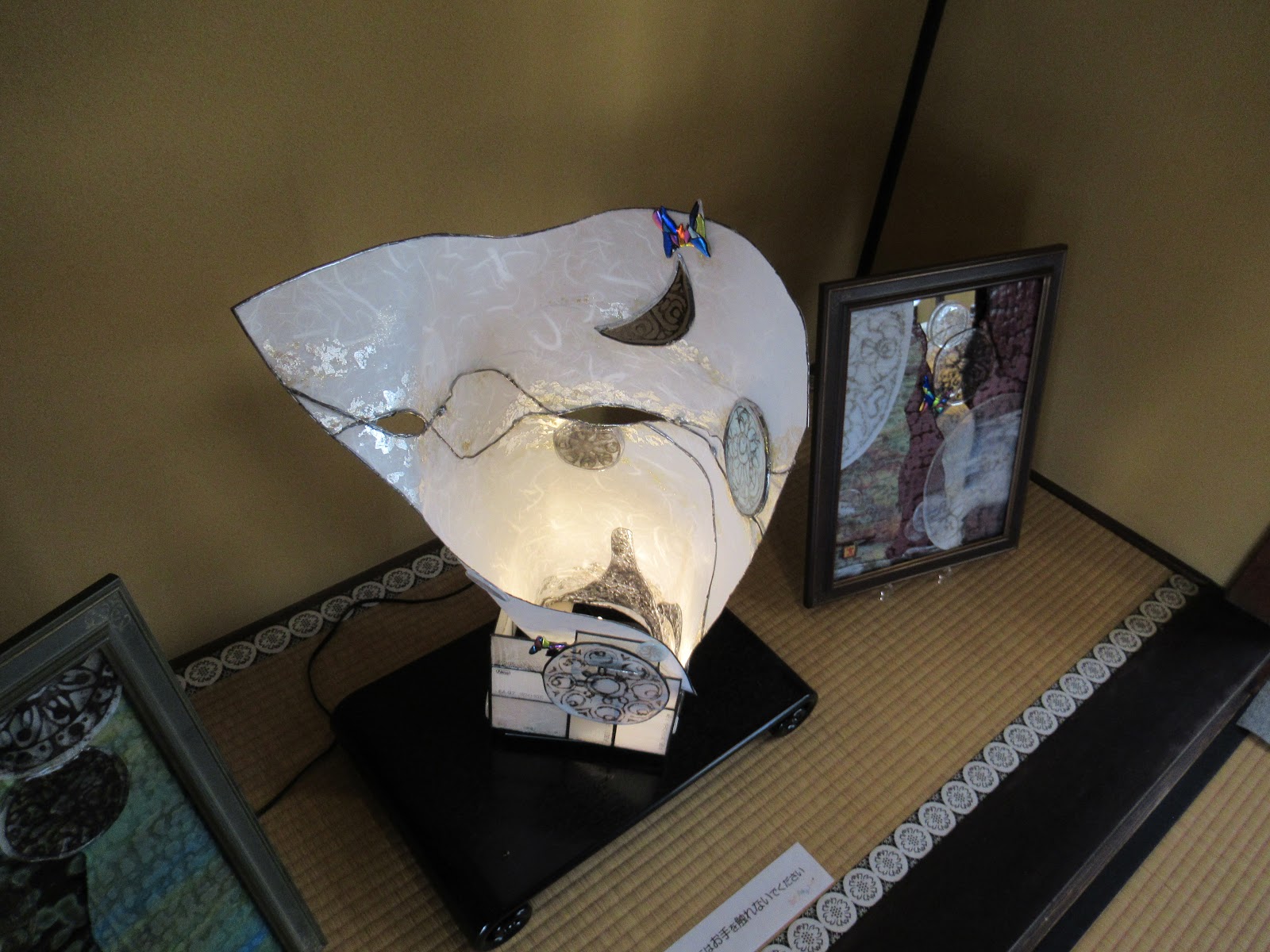
This museum was one of the admission-free sightseeing spots on October 20. I visited there partly because I like to see stained glass. In the entrance hall, there were big beautiful pieces that welcomed visitors.


When I looked this one, I remembered that Sadayakko herself used to dance and play musical instruments. She was a famous geisha in Tokyo before she married Otojiro Kawakami. With her husband, she toured around the U.S. and Europe and performed brilliantly as an actress.


This is her poster (replica) by a Swiss Painter Alfred Muller for the 1900 Paris Exhibition. She was praised by Rodin, and Picasso painted her performing on the stage.


This kimono is her only stage costume that remains today. It was very big. There was also a replica of a halberd. It is called naginata in Japanese and was often used by women during the Warring States period. I imagined how powerfully she had performed on the stage with this long weapon in her hands.


Sadayakko retired from acting after her husband Otojiro died in 1911. She started to live in this house with her first love, Momosuke Fukuzawa; they met for the first time around 1885 when they were teenagers. Futaba Museum has many tatami rooms with Sadayakko’s belongings displayed. I think she had good taste. For example, I had never seen a hibachi (appliance to warm up the room with charcoal) like this.


This is her shamisen, a musical instrument she used to play.


On the black suitcase, there are initials “M.F.” The brown case on the right has a label “HOTEL (?) CONTINENTAL PARIS.” Maybe it had traveled around Europe with Sadayakko.


These are Sadayakko’s writing desk and cushion.


In the museum, they had also an exhibition of stained glass. This one was displayed on the first floor. The combination with Chinese characters was interesting.


The stairs to the second floor were beautiful.


There were more pieces of stained glass on the second floor. I learned that you can used stained glass in many ways.


This one was used for the poster of this exhibition. It was fantastic.


I liked this combination very much. Like Futaba Museum itself, it was a wonderful combination of Western and Japanese cultures.


This time, I walked to the museum from Tokugawaen. But you can take the Nagoya Sightseeing Route Bus “Me-guru”, which may be the easiest way to get there. The website “NAGOYA-INFO” provides various information for tourists.

Happy New Year of Ox 2021

If you are in Japan during the year-end and New Year holidays, you can see many pretty sweets at Japanese confectionary stores. As 2021 is t...