Showing posts with label Local Sightseeing & Events. Show all posts

Monday, August 17, 2020

Mein Schloss - Craft brewery & Beer hall restaurant

As I wrote before in this blog, I can’t drink alcohol. On the contrary, my sister loves drinking and has never got drunken. Since she will soon hit the big ?-oh, I wanted to send something special for her birthday. So, I went to Mein Schloss (My Castle) near JR Hamamatsu Station.


Mein Schloss is a beer hall restaurant with a brewery and a courtyard. I have once had a pizza that was like Pizza Margherita in the restaurant. The interior and atmosphere were very much like those in German beer halls I had seen on TV and more impressive than the pizza itself. Other people were eating sausages that also looked very German. You can feel as if you were in Germany. Under this corona period, the restaurant seems to take more strict measures than other places in Hamamatsu. They take customers’ temperatures and request customers to wear a mask when they walk around in the building.


This time, I just visited their shop on the left to buy the present. Behind the counter, there was a series of beer. I chose a set of four types of beer Schwarz, Alt, Helles, and Weisen. They were made in the brewery of Mein Schloss and labeled as “HAMAMATSU BEER.” According to the website, their products are made according to German Reinheitsgebot (purity order). This law was originally established by Wilhelm IV in Bavaria in 1516 and limited the ingredients of beer to just water, barley, and hops (yeast was added later). It is interesting to know that all these different types of beer are made from the same simple ingredients.


The shop of Mein Schloss has also some food from abroad such as pickles, cookies and gummi candies and souvenirs of Hamamatsu. I bought bottles of cucumber pickles and olives home.


In addition, I found some beautiful Christmas ornaments from Germany. It was funny to see snowmen in the middle of summer.


These wooden ornaments somehow reminded me of German bread Brezel. You can eat one in the restaurant.


In the Christmas season, the courtyard will have gorgeous illumination at night. Even in summer, it was nice to see with parasols and flowers.


Now it is almost impossible to go overseas because of covid-19. But even if you are in Hamamatsu, you can see something German in Mein Schloss, and there is also Hamamatsu Museum of Musical Instruments that presents musical instruments from all over the world. It is just a few minutes walk from Mein Schloss.


Yesterday, my sister sent me a mail to inform that she received the beer. She said she would have it for dinner with steak and tortilla chips. I wished I could drink beer because tortilla chips surely go well with beer and the temperature was 40 degrees here, which I had never experienced before.

Mein Schloss
Address:  8-1 Chuo 3-chome, Naka-ku, Hamamatsu-shi, Shizuoka
Tel: 053-452-1146
Opening hours: Weekdays 11:00 - 14:30, 17:00 - 23:00
                       Saturday 11:00 - 23:00
                       Sunday and holidays 11:00 - 22:00
Closed: Monday, December 31 and January 1
Access: 8-minute walk from JR Hamamatsu Station

Wednesday, August 12, 2020

Hamamatsu Reconstruction Memorial

August is the month when Japanese people recall the experiences of World War II. Due to the militarism that arose in the Meiji Period (1868-1912), Japan started to invade neighboring countries already in the second half of 19th century. It colonized Taiwan and Korea, established a puppet state Manchuria in China, and started a war with China (Sino-Japanese War). To get natural resources, invasion to Southeast Asia was also started, and the Pacific War with the Allies broke out in 1941. The war ended in August 15, 1945, after atomic bombs were dropped in Hiroshima and Nagasaki. Every year, a siren is blown all over Japan on August 6 and 9, exactly at the same time when the bombs were dropped. Then we pray for the souls of the victims of the bombs. On August 15, we hear a siren at noon and remember the end of the war.

Even before the atomic bomb attacks, many cities were bombed and destroyed during the Pacific War. A Japanese animation film “Graves of the Fireflies (火垂るの墓 (hotaru-no-haka))” depicts the air raid in Kobe. Though Hamamatsu was a relatively small city with a population of 187,433 (as of 1944), it had 27 air raids in total. It was partly because Hamamatsu is located between big cities such as Tokyo and Osaka, and American bombers dropped the remaining bombs here to dispose of them after attacking these cities. Another reason is that Hamamatsu is an industrial city and had many factories producing weapons. For example, the factory of Yamaha, a musical instrument company, made propellers of aircrafts at that time. By the end of the war, more than 3,500 citizens were killed, and most of the city was destroyed. In Hamamatsu Castle Park, there is a memorial of it.


In a quiet area near the downtown, there is a small museum called Hamamatsu Reconstruction Memorial to present the life under the war and the reconstruction after that. In summer, many groups of local school children visit there with their teachers. But this year, the museum has much less visitors because of covid-19. As it has been 75 years since the end of the war and I live near the museum, I visited there to remember the history of the war today.


The exhibition is started with a big panel with pictures of the destroyed downtown. I think this picture is the most familiar to people in Hamamatsu as it is used in many materials describing the history of the city.


These are fragments of bombs.


Incendiary bombs are also displayed with description of the mechanism.


In the next room, you can see people’s daily life under the war. At that time, men wore a national uniform that resembled the military uniform. On the left of the uniform, there were an air-raid hood and helmet to protect the head from air raids.


Women usually wore work pants and regularly participated in a fire drill with bucket brigade training. With the Anti-Aircraft Defense Law, the Japanese government obliged ordinary people to extinguish fire caused by air raids and prohibited them from running away. This increased the number of victims of air raids.


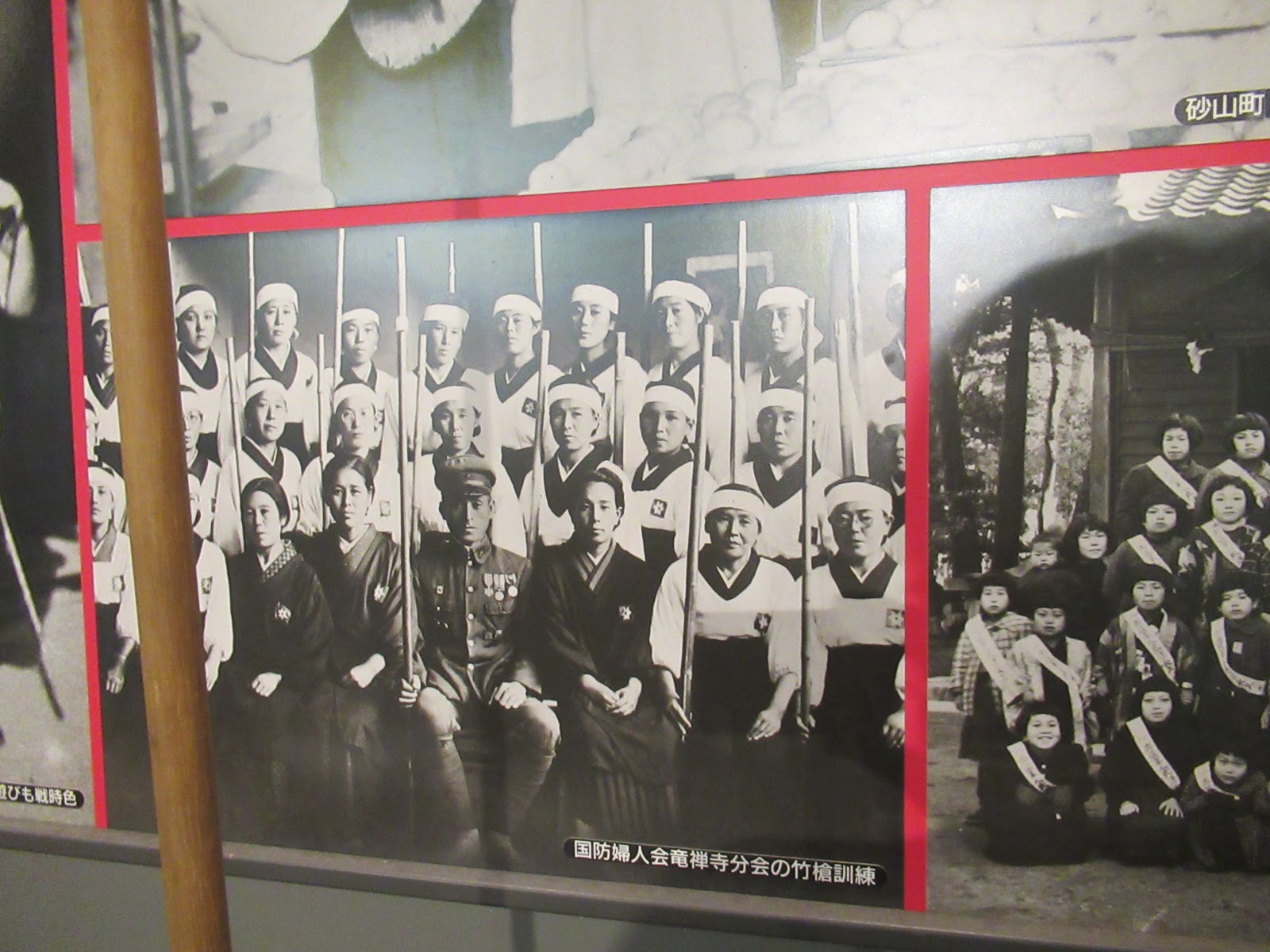
In addition to a fire drill, women were trained to fight against enemies with bamboo spears in case they would land in Japan.


Even children played at soldiers.


These pictures convey such an unusual atmosphere or madness during the war. For me, the most shocking exhibit in the museum was a diary written by a 15-year-old student who was mobilized and worked at a factory to support the production of weapons. Her wording and handwriting were like those of an adult. I suppose she was a hardworking and intelligent girl and might be a kind of roll model for other students at that time. In the last part, she emphasized that they should increase the production of weapons to reward the efforts of soldiers. The day after she wrote this, she was killed in an air raid to the factory.


It has been 75 years since the end of the Pacific War. I think we should remember not only how the life was during the war but also how the war occurred. Many years ago, I read a series of comic books “Barefoot Gen (はだしのゲン (hadashi-no-gen))” in this museum. It was drawn by Keiji Nakazawa, a survivor of the atomic bomb in Hiroshima. He depicts the daily life of Hiroshima during the wartime based on his childhood memories. In this work, the father of the main character Gen is against the war and says to his children: “Don’t be deceived, children. You should get along with all the people in Korea and China. It is the only way to prevent a war.” I think this message is very important, especially now.

Hamamatsu Reconstruction Memorial also exhibits everyday objects in old days.


I got interested in this classic shaved ice machine. How old is it? When I saw it, I felt like eating the soda popsicle GariGarikun. Now the temperature is around 35℃, and it will be continuously hot this week.


Hamamatsu Reconstruction Memorial
Address: 304-2, Togi-machi, Naka-ku, Hamamatsu-shi, Shizuoka
Tel: 053-455-0815
Opening hours: 9:00-17:00
Closed: Mondays (if a national holiday falls on Monday, it is closed the next day instead), December 29 - January 3, the day after a national holiday)
Access: 10-minute walk from JR Hamamatsu Station

Thursday, July 30, 2020

Local swimming event to prepare for tsunami

July is almost over. Usually, all the 5th graders in elementary schools in Hamamatsu participate in an annual event called “30-minute circular swimming” in this month. But it was cancelled this year because of covid-19. In Japanese, this event is called “sanjuppunkan kaiei (30分間回泳).” I think most Japanese people have never heard of it or don’t know what it exactly means. This is a unique event in Hamamatsu that is hardly seen elsewhere.

In 30-minute circular swimming, children are supposed to swim for 30 minutes without touching the bottom of the pool. It is held in a big pool, and children from two (or more?) elementary schools swim together at a time in circle (There are 97 elementary schools in total). After several minutes from the start, a flow of water is generated, which allows them to swim more easily. Since the most important thing is to sustain themselves in water, children can swim in any style. It is ok to just allow themselves to float on water to be carried forward by the flow. I have heard more than 90% of children succeed in this challenge every year and get a certificate. It’s amazing!

This event has been held since 1966. When I was a 5th grader, it was held in a municipal pool near the castle. It was so deep that children could not reach the bottom. I was scared and got out of the pool after 3 minutes. It was no problem then because I didn’t need to have a “makeup test.” In recent years, children who couldn’t swim for 30 minutes should try again next year.

Now the old municipal pool no longer exists, and this event is held in ToBio (Furuhashi Hironoshin Memorial Hamamatsu Swimming Pool). It is a swimming facility nicknamed after Furuhashi Hironoshin (古橋廣之進, 1928 - 2009), who was an Olympic freestyle swimmer from Nishi Ward of Hamamatsu and called “flying fish (tobiuo) of Fujiyama”. He set some world records after World War II and led the swimming world in Japan.

As a child, Furuhashi Hironoshin used to swim in Lake Hamana. As you see in this map, Hamamatsu is surround by water, Lake Hamana, Pacific Ocean, and Tenryu River.


The event of 30-minute circular swimming is intended to prevent children from water accidents. They say that in case a tsunami occurs, if you can sustain yourself in water for 30 minutes, you will have a greater chance to be rescued. I don’t know if it is true or not, but 30-minute circular swimming is surely an unforgettable summer memory for many people in Hamamatsu.

Monday, May 11, 2020

Fresh green leaves & tea leaves

May is the season of newly harvested tea. Last year, my mother, sister, and I went to Mori-machi, a town about 30 km from Hamamatsu and visited a tea shop Ishikawaen (石川園). In April this year, we got a brochure of their products including new tea leaves and a tea bag by post.


When I visited my parents’ house on May 5, my mother took me for a drive to Mori-machi as it was the last day of the annual sale of newly harvested tea. I got out of Hamamatsu for the first time in more than two months and had a feeling of freedom in the nature. We enjoyed the beautiful scenery of mountains with fresh green leaves. There weren’t many cars running on the road in front of Ishikawaen.


Last year, they had a tent in front of the shop and offered a cup of free green tea and Ochabatake (tea garden) Yokan (thick jelly made from adzuki beans, agar, sugar, etc.) containing green tea to each visitor. But this year, they didn’t do that


and had a disinfectant at the entrance.


My mother bought some tea leaves and a box of Ochabatake Yokan.


I ate one piece of yokan at home with the tea sent from Ishikawaen in April. The yokan (5 cm x 3 cm) was dark green and had a rich flavor of green tea.


The contents of the tea bag consisted of green tea, Gyokuro (玉露), and powdered green tea. Gyokuro is the highest quality green tea. Before harvesting, its tea plants are covered to be protected from sunlight for three weeks to increase sweetness and decrease bitterness. The tea bag is intended to make tea with 400 cc of cold water. The pale green color of tea was beautiful, and the tea had a mild refreshing flavor.


Ishikawaen is a generous tea shop. Before we left, they gave another tea bag of this tea and a small bag of newly harvested tea to each of us. I think I’ll send them to my sister who has stayed in Tokyo all the time.

In Mori-machi, we also visited Daitoin Temple,


where we found thistles that can be rarely seen in the area where we live,


and went to FamilyMart. Though it is a convenience store chain, this store has a corner of locally produced vegetables and fruits.


I bought a pack of strawberries at a reasonable price. Though they were small, they tasted very good. Such simple local products always give me energy.


Wednesday, May 6, 2020

Believe in our future

Today is the last day of our holiday season called the Golden Week. Since the government declared a state of emergency for the coronavirus that covers all over Japan until May 6, we are expected to stay at home to the extent possible. Even in Hamamatsu, many restaurants have responded to the request from the city to close until May 6.

The holiday season has passed calmly. The population of Hamamatsu is about 800,000. Until now, seven people have been infected, but there has been no new case found for three weeks. Though the state of emergency has been extended until the end of May, the city doesn’t extend the period of the request for closure. The local restaurants will be opened tomorrow.

Under such circumstances, the city made a video “Believe in our future – Hamamatsu, Japan” to promote sightseeing after recovery from COVID-19. It is posted on YouTube:
https://www.youtube.com/watch?v=5eVqehSWeik

Though it is a very short video, it contains beautiful scenery of Hamamatsu Castle, Lake Hamana, etc. in spring. On YouTube, I found some other interesting videos about Hamamatsu:

SHIZUOKA 【Cherry blossoms】“Somei-Yoshino” at Hamamatsu Flower Park 2020.
https://www.youtube.com/watch?v=jKvQ3Iqke8s

【大迫力】これぞ大凧あげ! 浜松まつり 開会式の混戦を揚げきる
https://www.youtube.com/watch?v=hKMVHivXrro&t=530s
(Hamamatsu Festival with exciting kite flying)

Hamamatsu Kite Festival – Celebrating the New Born Baby - Flying Kite
https://www.youtube.com/watch?v=5RjxcFWFN1I
(Short video with a new-born baby, his parents, and neighborhood)

As I wrote yesterday, Hamamatsu Festival was canceled this year. I wish the Japanese government will learn from the success of our neighboring countries to take useful measures against COVID-19 as soon as possible so that we can have a powerful festival next year.

Scenery near the kite flying field

Thursday, April 9, 2020

Cherry blossoms in bloom

Now is the season of cherry-blossom viewing. Yesterday I went to Hamamatsu Castle Park. It was early in the morning and there were only a few people jogging or walking. Cherry blossoms were in bloom like these over the pond.


Green leaves, pale pink blossoms, blue sky…


These blossoms were also beautiful though I don’t know their name.


In the center of the city, Hamamatsu Castle Park may be the best spot for cherry-blossom viewing. But Central City Library has also a nice cherry tree in front of it.


Under the tree, there is a monument of Kuraji Ishikawa (1859 - 1944) who was born in Hamamatsu and founded the Japanese braille system.


The website of Hamamatsu City Library provides links to information about the coronavirus available in several languages (https://www.lib-city-hamamatsu.jp/osirase/osirase_link_covid-19_multi.html). The information is well described, including how to wear a mask correctly.

Sunday, March 1, 2020

Hina-dolls in Kasuisai Temple

The Doll Festival is coming soon. It is held on March 3 every year to pray for healthy growth of girls with a set of hina-dolls displayed at home. The most typical set consists of the imperial pair, three court ladies, five musicians, two guardians, three servants, furniture, etc. When a daughter born in a family, it is often the girl’s grandparents on mother’s side who present her with such dolls. But it depends on families.

In addition to families, many museums and sightseeing spots have exhibitions of hina-dolls at this time of year. Kasuisai Temple in Fukuroi (about 17-minute train ride from Hamamatsu) has one of the largest collections of hina-dolls in Japan. Their exhibition started from the beginning of January, and now they have some other interesting things to see. Last week, I visited there and had a very good time.

It takes about 40 minutes from JR Fukuroi Station to Kasuisai Temple on foot. This time I could take a bus immediately after arriving at the station, though there is only one bus an hour. It took about 10 minutes to get to the bus stop “Entrance of Kasuisai.” The first hina-dolls I saw were those sitting on the stone stairs to the temple. Though I had heard about it before, I was surprised at the sight.


Along the corridors of the temple, there were dolls of imperial pairs.


Some of them had gorgeous hair ornaments.


Some were enjoying tea.


This is a princess from a Japanese classic “The Tale of Genji.”


Court ladies were also elegant.


I liked this comical doll of a servant.


They looked cute with pink and white rice cakes in front of them.


The highlight of the exhibition is these 1,200 dolls on 32 steps. It was awesome. The room itself was splendid with the beautiful design of the ceiling.


On the opposite side of the room, ceremonial kimono in actual size were displayed. The women’s kimono has twelve layers. I imagined it was heavy to wear.


The men’s kimono is much simpler.


This is a set of traditional hanging lucky charms called “Kasafuku (literally means umbrella luck)” from Sakata in Yamagata Prefecture. There are as many as 999 pieces and made by 12 people.


Turtles for a long life, gourds for good health, balls, patchworks, etc. They were so colorful.


Even the garden of the temple had a festive atmosphere. They had dolls outside as well. There are five musicians.


A knight on a white horse like in European folktales?


I think this pair may be the most romantic of all. It looked like a scene from a love story.


You may wonder why a temple has so many hina-dolls or where the dolls came from. As I explained, girls were given hina-dolls when they were born. After they have grown up, the role of the dolls for protecting the girls is over. They are brought to a temple or shrine for a memorial service and burned there. Many people treat their hina-dolls carefully as if they had souls and don’t dare to discard them directly. The dolls in Kasuisai Temple may have been such dolls. Each of them had its individual characteristics and a presence.

Until March 15, Kasuisai Temple provides a special vegetarian set for the Doll Festival. It should be reserved by more than one person in advance. It costs 3000 yen and more expensive than other seasonal sets. I couldn’t eat it, but they will have Peony Festival in their peony garden from April to May, and I think they will have another seasonal set then. Even now, they have an indoor peony exhibition, but the flowers were less beautiful than before. So, I’ll show you a picture taken in January. Kasuisai Temple is a great culture spot with events and beautiful interior decoration of the temple itself.


Happy New Year of Ox 2021

If you are in Japan during the year-end and New Year holidays, you can see many pretty sweets at Japanese confectionary stores. As 2021 is t...