Super Typhoon Hagibis is gone. In Hamamatsu, it started raining in the evening the day before yesterday. We had heavy rain accompanied with strong wind until yesterday evening, however, the rain weakened after 18:00. I was relieved then though the wind was still blowing violently. While I was watching some films with a headphone, I could take off my mind from it. When I went to bed, I didn’t need to worry about a power outage anymore.
The typhoon made a landfall on the Izu Peninsula in eastern Shizuoka Prefecture around 19:00. Then it moved toward the Kanto area including Tokyo. When I woke up this morning, it was fine. As I was at home all day yesterday, I went out for several hours during the daytime. The sun was shining, and there was no cloud in the sky. The temperature was nearly 30 degrees. It was too hot in the middle of October. The Magome River, whose water level once increased to a dangerous level, seemed normal today. Yesterday, the city sent a message to our cell phones to urge people living near the river to evacuate.
According to the website of NHK (national broadcasting organization), 21 people died, and 16 people are missing (as of 16:41, October 13). There are also 166 people who are injured. I have also learned that in several areas such as Hakone, Ichiyama in Izu, and Kawauchi Village in Fukushima Prefecture, the precipitation of these one to two days was record-breaking and amounted to 30 - 40% of annual precipitation. And enbankments in 21 rivers collapsed in Tohoku and Kanto Districts and Nagano (City). In recent years, there have been too many “record-breaking” disasters. The politicians should take the climate crisis and Greta Thunberg's speech seriously and take concrete measures.
Introduction of Delicious Food, Restaurants, and Sightseeing Spots
Showing posts with label Climate Change. Show all posts
Sunday, October 13, 2019
Friday, October 11, 2019
Super typhoon is coming
Last year, people in Shizuoka Prefecture experienced a strong typhoon that caused a power outage for more than 780,000 households. It was at the end of September, and I was traveling in Sweden. When I came home at the beginning of October, the neighborhood I live in had already recovered from the power outage. But it took seven days for the entire area of Hamamatsu to recover completely.
Last month, Chiba Prefecture was hit by a severe typhoon. The recovery is still ongoing, however; another typhoon is coming. It is Super Typhoon Hagibis, which is known as Typhoon #19 in Japan. It is expected to make landfall on the main island Honshu tomorrow, causing heavy rain especially in Central Japan and Kanto District including Tokyo. Because of this typhoon, all Shinkansen service from Tokyo to Nagoya will be canceled on October 12.
As this is my first time to experience a super typhoon, I have been nervous these days. Yesterday, I bought a pack of 8 dry cells for my flashlight. I heard that my parents had used a candle during the power outage last year, but it is much safer to use a flashlight.
On the Internet, there were websites that give tips about how to prepare for a typhoon. I have bought three packs of rye bread in the basement of the JR Hamamatsu Station building, three 2-liter bottles of water, bananas, and apples in case that tap water and gas won’t be available (since packs of rye bread lasts for several months, they are also convenient to keep as emergency food for an earthquake). I have taken the flowerpots and the wash-line pole on the balcony into the room so that they wouldn’t break or move to somewhere. It is also necessary to fill the bathtub to keep water for the sink and the toilet. But I can do it tomorrow. I will stay at home all day as it may be almost impossible to go out.
Last month, Chiba Prefecture was hit by a severe typhoon. The recovery is still ongoing, however; another typhoon is coming. It is Super Typhoon Hagibis, which is known as Typhoon #19 in Japan. It is expected to make landfall on the main island Honshu tomorrow, causing heavy rain especially in Central Japan and Kanto District including Tokyo. Because of this typhoon, all Shinkansen service from Tokyo to Nagoya will be canceled on October 12.
As this is my first time to experience a super typhoon, I have been nervous these days. Yesterday, I bought a pack of 8 dry cells for my flashlight. I heard that my parents had used a candle during the power outage last year, but it is much safer to use a flashlight.
On the Internet, there were websites that give tips about how to prepare for a typhoon. I have bought three packs of rye bread in the basement of the JR Hamamatsu Station building, three 2-liter bottles of water, bananas, and apples in case that tap water and gas won’t be available (since packs of rye bread lasts for several months, they are also convenient to keep as emergency food for an earthquake). I have taken the flowerpots and the wash-line pole on the balcony into the room so that they wouldn’t break or move to somewhere. It is also necessary to fill the bathtub to keep water for the sink and the toilet. But I can do it tomorrow. I will stay at home all day as it may be almost impossible to go out.
Tuesday, September 24, 2019
High school students in Hamamatsu inspired by Greta Thunberg
Yesterday the 16-year-old climate activist Greta Thunberg made a speech at the UN Climate Action Summit. I saw her video on the Internet for a few times. In her speech, she was expressing her emotions straight toward world leaders who hadn't worked on the climate crisis seriously. I had never seen her speaking like that before. She said; "We are in the beginning of a mass extinction, and all you can talk about is the money and fairy tales of eternal economic growth. How dare you!” While critizing world leaders, she repeated "How dare you!" a few times. She also said; “If you choose to fail us, I say we will never forgive you.” Throughout the speech, my heart ached as I saw her expressions. I saw how angry and sad she was.
I wonder how our new environment minister Shinjiro Koizumi felt hearing her speech. He also attended the UN Climate Action Summit. Soon after his arrival at New York, he went to a steak house for dinner. He said that he wanted to eat steak every day. How dared he! Apparently, he doesn’t know the relationship between the livestock industry and climate change. This topic is ignored by Japanese media, and people are poorly informed even though they are politicians.
Recently, Greta Thunberg and her school strike have been increasingly covered by Japanese newspapers and TV programs. But I haven’t found any articles that mentioned that she is a vegan to reduce the effects on the environment. I think they must write about her lifestyle as well as her activities. She not only demands politicians to take actions, but she herself leads an environmentally friendly lifestyle.
On September 20, 4 million people participated in the global climate strike. Even in Hamamatsu, about 400 students in Kaiseikan, a combined private junior and senior high school, marched from JR Hamamatsu Station to the city hall with placards and balloons. They appealed to people in the town by shouting “Save the planet, save our future!” Finally, they handed recommendations to the mayor to require implementation of RE100 in schools and hospitals, establishment of a “youth conference” to collect opinions of young people about climate change, promotion of greening in the urban area, etc. They responded to Greta’s call to children in the world.
I was surprised to hear this news because I had thought the global climate strike would be held in only big cities. But I was wrong. I have the book “No One is Too Small to Make a Difference”, a collection of Greta’s speeches. I wish this book will be used in English classes in high schools all over Japan so that more and more students will get interested in the world they live in.
I wonder how our new environment minister Shinjiro Koizumi felt hearing her speech. He also attended the UN Climate Action Summit. Soon after his arrival at New York, he went to a steak house for dinner. He said that he wanted to eat steak every day. How dared he! Apparently, he doesn’t know the relationship between the livestock industry and climate change. This topic is ignored by Japanese media, and people are poorly informed even though they are politicians.
Recently, Greta Thunberg and her school strike have been increasingly covered by Japanese newspapers and TV programs. But I haven’t found any articles that mentioned that she is a vegan to reduce the effects on the environment. I think they must write about her lifestyle as well as her activities. She not only demands politicians to take actions, but she herself leads an environmentally friendly lifestyle.
On September 20, 4 million people participated in the global climate strike. Even in Hamamatsu, about 400 students in Kaiseikan, a combined private junior and senior high school, marched from JR Hamamatsu Station to the city hall with placards and balloons. They appealed to people in the town by shouting “Save the planet, save our future!” Finally, they handed recommendations to the mayor to require implementation of RE100 in schools and hospitals, establishment of a “youth conference” to collect opinions of young people about climate change, promotion of greening in the urban area, etc. They responded to Greta’s call to children in the world.
I was surprised to hear this news because I had thought the global climate strike would be held in only big cities. But I was wrong. I have the book “No One is Too Small to Make a Difference”, a collection of Greta’s speeches. I wish this book will be used in English classes in high schools all over Japan so that more and more students will get interested in the world they live in.
Tuesday, August 13, 2019
Bus tour to Mt. Ibuki (2) - Efforts for revival of wildflower
From Yoro SA, it wasn’t very distant to get to Mt. Ibuki Driveway. We could enjoy exciting views as the bus climbed up the mountain. When we arrived at the parking lot near the summit, it was 12:10. We should be back by 15:40 after enjoying hiking freely. When we got off the bus, it was so foggy that we couldn’t see anything beneath the mountain. In the toilet near the parking lot, there was no toilet paper set inside, because it would soon get wet because of the weather. But you could buy some from a vending machine.
Between the parking lot and the summit, there were three routes. The eastern route was for climbing down only as it was longer and more difficult to walk than the other two routes. The center route was the shortest but the steepest. So, we took the western route. Near the starting point, there was a statue of Kannon or Goddess of Mercy who helps you succeed in love.
Since last Sunday was our national holiday “Mountain’s Day”, there were volunteers of Ibukiyama Moribitonokai. According to their website, this is an organization that informs visitors about nature and culture of Mt. Ibuki and conducts awareness-rising activities about importance of environmental conservation. First, we got a brochure about flowers on the mountain at the starting point. Soon after we started walking, we noticed that the peak flower season was already over. However, there were still many yellow flowers in bloom. According to a brochure, they are Senecio nemorensis.
My mother found mugworts.
On our way to the summit, there was another volunteer, who taught us the names of flowers. It was also interesting to hear about the weather on the mountain. According to him, beautiful sunrise could be seen from there the day before.
As we climbed up higher, we could see more flowers in bloom. This one had a bee.
But the road became rougher.
This is a field of meadowsweet. Six years ago, members of Ibukiyama Moribitonokai planted young plants of meadowsweet for their revival as they were decreasing significantly because of climate change and for some other reasons.
It was also interesting to see big rocks.
On Mt. Ibuki, it was easy to come closer to some rare insects. This is a butterfly on a thistle flower.
It took us about an hour to get to the summit. It’s time to have some refreshment. Mt. Ibuki is the highest mountain in Shiga Prefecture with a height of 1,377 m.
My mother and I drank Fanta and Mitsuya Cider respectively. Mitsuya Cider is just a carbonated soft drink first made in 1884 and totally different from English cider. Though it was foggy, it was still refreshing to drink it.
Between the parking lot and the summit, there were three routes. The eastern route was for climbing down only as it was longer and more difficult to walk than the other two routes. The center route was the shortest but the steepest. So, we took the western route. Near the starting point, there was a statue of Kannon or Goddess of Mercy who helps you succeed in love.
Since last Sunday was our national holiday “Mountain’s Day”, there were volunteers of Ibukiyama Moribitonokai. According to their website, this is an organization that informs visitors about nature and culture of Mt. Ibuki and conducts awareness-rising activities about importance of environmental conservation. First, we got a brochure about flowers on the mountain at the starting point. Soon after we started walking, we noticed that the peak flower season was already over. However, there were still many yellow flowers in bloom. According to a brochure, they are Senecio nemorensis.
My mother found mugworts.
On our way to the summit, there was another volunteer, who taught us the names of flowers. It was also interesting to hear about the weather on the mountain. According to him, beautiful sunrise could be seen from there the day before.
As we climbed up higher, we could see more flowers in bloom. This one had a bee.
But the road became rougher.
This is a field of meadowsweet. Six years ago, members of Ibukiyama Moribitonokai planted young plants of meadowsweet for their revival as they were decreasing significantly because of climate change and for some other reasons.
It was also interesting to see big rocks.
On Mt. Ibuki, it was easy to come closer to some rare insects. This is a butterfly on a thistle flower.
It took us about an hour to get to the summit. It’s time to have some refreshment. Mt. Ibuki is the highest mountain in Shiga Prefecture with a height of 1,377 m.
My mother and I drank Fanta and Mitsuya Cider respectively. Mitsuya Cider is just a carbonated soft drink first made in 1884 and totally different from English cider. Though it was foggy, it was still refreshing to drink it.
Tuesday, May 28, 2019
Veggie hot dog newly launched in IKEA
Last Saturday, after visiting the exhibition in Matsuzakaya Museum, I went to IKEA in Nagakute, a town adjacent to Nagoya. On May 16, IKEA introduced a veggie hot dog and a plant-based banana soft-serve ice cream in the bistros in their stores. I was excited to hear that as I had never been in their bistro due to the lack of vegetarian/vegan options.
At IKEA, I was surprised to see how many people were standing in the line in front of the ticket vending machines. But the line moved faster then I expected, and I could get both veggie hot dog and soft-serve ice cream smoothly. I tried the ice cream first before it would melt. I heard this is 100% plant-based and made from only banana juice. It had a light taste and quenched my thirst.
The veggie hot dog cost only 100 yen, but it was satisfactory to eat. It was made from chickpeas, green peas, kale, carrot, etc. and reminded me of the vegan sandwich I had in SUBWAY in Rovaniemi, Finland last year. It had also red cabbage on top, and I added ketchup and mustard. I thought it was a good value for the price.
According to IKEA, the CO2 emission of the veggie hot dog is 10% of that of the conventional pork hot dog. Though the bun still contains egg and dairy products, it will be vegan in the future. I also learned that 30% of their customers in Japan come to IKEA to eat. I hope more and more people get interested in sustainable and healthy food provided there. From June, they will have a plant-based food fair with two new kinds of veggie hot dogs.
In addition to visit to the bistro, I had another important thing to do at IKEA. These are wholegrain crisp rolls, multigrain crispbread, rye crispbread, and sugar-free oat biscuits I bought in the food market. All of them seem to be vegan.
In addition to them, I bought also thin bread, my favorite, which I have already eaten up.
At IKEA, I was surprised to see how many people were standing in the line in front of the ticket vending machines. But the line moved faster then I expected, and I could get both veggie hot dog and soft-serve ice cream smoothly. I tried the ice cream first before it would melt. I heard this is 100% plant-based and made from only banana juice. It had a light taste and quenched my thirst.
The veggie hot dog cost only 100 yen, but it was satisfactory to eat. It was made from chickpeas, green peas, kale, carrot, etc. and reminded me of the vegan sandwich I had in SUBWAY in Rovaniemi, Finland last year. It had also red cabbage on top, and I added ketchup and mustard. I thought it was a good value for the price.
According to IKEA, the CO2 emission of the veggie hot dog is 10% of that of the conventional pork hot dog. Though the bun still contains egg and dairy products, it will be vegan in the future. I also learned that 30% of their customers in Japan come to IKEA to eat. I hope more and more people get interested in sustainable and healthy food provided there. From June, they will have a plant-based food fair with two new kinds of veggie hot dogs.
In addition to visit to the bistro, I had another important thing to do at IKEA. These are wholegrain crisp rolls, multigrain crispbread, rye crispbread, and sugar-free oat biscuits I bought in the food market. All of them seem to be vegan.
In addition to them, I bought also thin bread, my favorite, which I have already eaten up.
Sunday, May 26, 2019
Exhibition of Astrid Lindgren and world’s strongest girl
Yesterday, I went to Nagoya to see an exhibition “Pippi Longstocking and the World of Astrid Lindgren” held in Matsuzakaya Museum. It is one of the memorial events for the 150th anniversary of the establishment of diplomatic relations between Sweden and Japan. Astrid Lindgren is a world-famous writer of children’s books whose image is used on the Swedish 20 crown bill.
In the exhibition, I could see many original drawings and paintings in her books. Pippi Longstocking is the most famous characters created by Astrid Lindgren, who is the strongest girl in the world.
When I was in elementary school, the TV series of Pippi was very famous among children. I think almost all the books of Astrid Lindgren are translated into Japanese. Personally, I like Emil series and was glad to see some humorous illustrations of Björn Berg.
But the most interesting things for me were two films about Astrid Lindgren. One of them presented her life and background, including interviews with her family members and celebration of her 80th birthday. The other film was an extraction of her speech “No Violence!” made in Germany in 1978. She was opposed to corporal punishment to children, and I was very impressed by her words. She said something like this: Children should respect their parents, but parents should also respect their children. I completely agree with her.
In the next year, 1979, Sweden became the first country that banned corporal punishment to children. But in Japan, there are still many parents and teachers who think such punishment is necessary though it is already 2019. They consider children as immature people and just want to control them without hearing their opinions and feelings. Children under the control of such adults are required just to be obedient.
When the Swedish teenager Greta Thunberg started the school strike for climate last year, I thought her very courageous. But at the same time, I felt the maturity of the Swedish society in which children are also treated as individuals with their own will and allowed to speak out what they believe. I didn’t think that there were any Japanese teenagers who could do the same.
On May 24, the 2nd Global Climate Strike took place all over the world. I heard that a climate strike was held in more than 100 places in Sweden. In Japan, 300 people gathered in Tokyo, and 100 in Kyoto. The numbers of participants have increased compared with the 1st Global Climate Strike. And in “Friday for Future Kyoto” on Twitter, I saw a picture in which someone was holding a board with a message “Go Vegan” written in both English and Japanese! Since the relationship between climate change and meat consumption is not widely known in Japan, I hoped many people would notice this message.
It has been hot today. In Hamamatsu, it was around 30 degrees during the day. But in Hokkaido, the northernmost part of Japan, the temperature reached 39.5 degrees, which was the highest temperature ever recorded.
In the exhibition, I could see many original drawings and paintings in her books. Pippi Longstocking is the most famous characters created by Astrid Lindgren, who is the strongest girl in the world.
When I was in elementary school, the TV series of Pippi was very famous among children. I think almost all the books of Astrid Lindgren are translated into Japanese. Personally, I like Emil series and was glad to see some humorous illustrations of Björn Berg.
But the most interesting things for me were two films about Astrid Lindgren. One of them presented her life and background, including interviews with her family members and celebration of her 80th birthday. The other film was an extraction of her speech “No Violence!” made in Germany in 1978. She was opposed to corporal punishment to children, and I was very impressed by her words. She said something like this: Children should respect their parents, but parents should also respect their children. I completely agree with her.
In the next year, 1979, Sweden became the first country that banned corporal punishment to children. But in Japan, there are still many parents and teachers who think such punishment is necessary though it is already 2019. They consider children as immature people and just want to control them without hearing their opinions and feelings. Children under the control of such adults are required just to be obedient.
When the Swedish teenager Greta Thunberg started the school strike for climate last year, I thought her very courageous. But at the same time, I felt the maturity of the Swedish society in which children are also treated as individuals with their own will and allowed to speak out what they believe. I didn’t think that there were any Japanese teenagers who could do the same.
On May 24, the 2nd Global Climate Strike took place all over the world. I heard that a climate strike was held in more than 100 places in Sweden. In Japan, 300 people gathered in Tokyo, and 100 in Kyoto. The numbers of participants have increased compared with the 1st Global Climate Strike. And in “Friday for Future Kyoto” on Twitter, I saw a picture in which someone was holding a board with a message “Go Vegan” written in both English and Japanese! Since the relationship between climate change and meat consumption is not widely known in Japan, I hoped many people would notice this message.
It has been hot today. In Hamamatsu, it was around 30 degrees during the day. But in Hokkaido, the northernmost part of Japan, the temperature reached 39.5 degrees, which was the highest temperature ever recorded.
Saturday, March 16, 2019
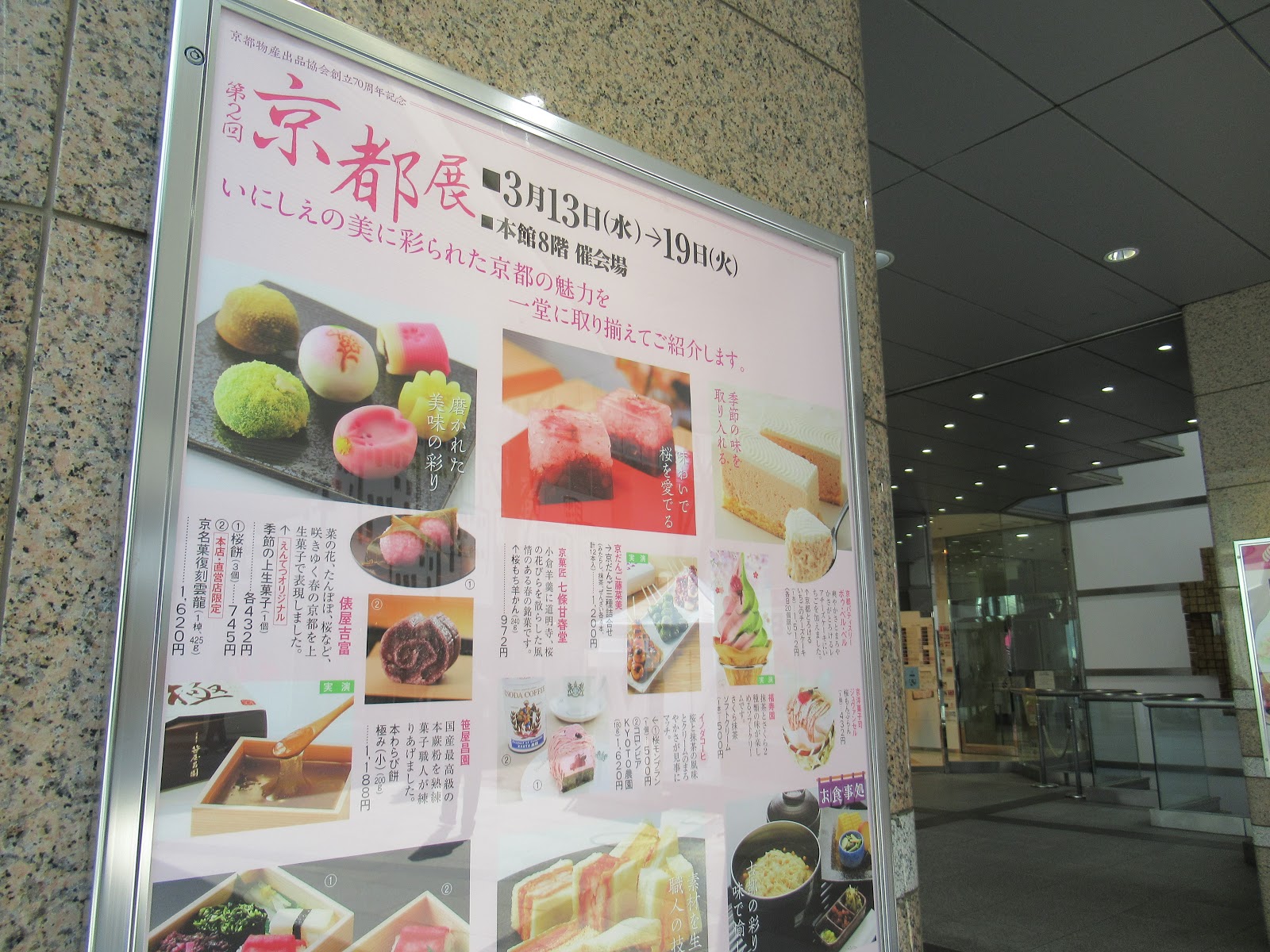
Kyoto Fair (1) - Variety of soy products
Kyoto is the former capital of Japan and has many cultural heritages including food. I’ve heard that there are many vegetarian restaurants in the city, which may be partly because of Buddhist tradition. Though many Buddhist monks eat meat nowadays, there are still temples where you can have vegetarian meals. Their dishes feature a variety of soy products that help them obtain protein.
Entetsu Department Store has Kyoto Fair now. I was looking forward to it, because I expected to find many kinds of traditional vegan-friendly food there.
The fair was crowded with people when I went there during lunch time yesterday. It was unexpected because it was not a holiday. As I strolled through stands, I heard elegant dialect of Kyoto from several shops. One of them was Kyonoyukihonpo (京乃雪本舗) that sold various soy products, and I bought ganmodoki for dinner.
I have already introduced them before as “pseudo-goose” in this blog. They are fried tofu balls with vegetables. The ones I found in the fair were rather big and had hu or wheat gluten inside. They looked like this. The pink things are the wheat gluten, which has a shape of a cherry blossom.
Last time, I grilled ganmodoki and ate them with soy sauce and garlic. But this time, I cooked it with tomatoes, garlic, and salt.
They were not bad. The flavor of tomatoes matched them, and the wheat gluten inside was soft and elastic. But I still thought that it was better to grill them. Fortunately, there are still two pieces left.
In the fair, there were some other shops that sold soy products. One of them was Yubaya (湯葉弥) that specializes in yuba or soy milk skins. They provide raw yuba, dried yuba, yuba cooked with other ingredients, and so on. I bought fried rolled yuba with pickled plums and shiso or Japanese basil.
I ate them with soy sauce. The flavors of the plums and shiso were not so strong. I thought they might be suitable to eat with beer though I can’t drink alcohol so much.
Yesterday was March 15, the day of “FridayForFuture.” It is a school strike movement that was started by a Swedish climate activist Greta Thunberg. Many young people in more than 120 countries in the world participated in it, responding Greta’s call. They required world leaders to take actions for global warming. In Japan, people gathered in Tokyo and Kyoto. It was inspiring. I wish those participated in FridayForFuture are or will become vegetarians or vegans because it is inevetable to reduce consumption of meat if you really want to stop climate change. Greta is a vegan and travels to other European countries by trains instead of airplanes. She is a girl of her word.
Entetsu Department Store has Kyoto Fair now. I was looking forward to it, because I expected to find many kinds of traditional vegan-friendly food there.
The fair was crowded with people when I went there during lunch time yesterday. It was unexpected because it was not a holiday. As I strolled through stands, I heard elegant dialect of Kyoto from several shops. One of them was Kyonoyukihonpo (京乃雪本舗) that sold various soy products, and I bought ganmodoki for dinner.
I have already introduced them before as “pseudo-goose” in this blog. They are fried tofu balls with vegetables. The ones I found in the fair were rather big and had hu or wheat gluten inside. They looked like this. The pink things are the wheat gluten, which has a shape of a cherry blossom.
Last time, I grilled ganmodoki and ate them with soy sauce and garlic. But this time, I cooked it with tomatoes, garlic, and salt.
They were not bad. The flavor of tomatoes matched them, and the wheat gluten inside was soft and elastic. But I still thought that it was better to grill them. Fortunately, there are still two pieces left.
In the fair, there were some other shops that sold soy products. One of them was Yubaya (湯葉弥) that specializes in yuba or soy milk skins. They provide raw yuba, dried yuba, yuba cooked with other ingredients, and so on. I bought fried rolled yuba with pickled plums and shiso or Japanese basil.
I ate them with soy sauce. The flavors of the plums and shiso were not so strong. I thought they might be suitable to eat with beer though I can’t drink alcohol so much.
Yesterday was March 15, the day of “FridayForFuture.” It is a school strike movement that was started by a Swedish climate activist Greta Thunberg. Many young people in more than 120 countries in the world participated in it, responding Greta’s call. They required world leaders to take actions for global warming. In Japan, people gathered in Tokyo and Kyoto. It was inspiring. I wish those participated in FridayForFuture are or will become vegetarians or vegans because it is inevetable to reduce consumption of meat if you really want to stop climate change. Greta is a vegan and travels to other European countries by trains instead of airplanes. She is a girl of her word.
Tuesday, December 18, 2018
Greta Thunberg - 15-year-old climate activist at COP24
Last summer, many countries suffered from extreme weather conditions and disasters. In Sweden, more than 50 forest fires occurred all over the country in July. I was sad to see burning forests on the Internet, remembering how I felt at ease to see forests from the airplane when I came to Northern Europe before. It was obvious that climate change had gone too far.
I read about Greta Thunberg for the first time in September when she went on school strike for the climate, sitting outside the Swedish parliament building to urge politicians to take actions. I thought her courageous, but my heart ached at the same time because I realized again how serious climate change had become, triggering a young student to take such an action.
Last week, Greta made a speech at COP24 in Poland. There she criticized world leaders who were too scared of being unpopular and didn’t take essential actions for climate change. I thought what she said was right.
As a climate activist, Greta leads an environmentally-friendly life. She went to Poland by an electric car instead of airplane. With her influence, the whole family has become vegan. Her mother is an opera singer and came to Japan for concerts before, but now she sings only in Sweden to reduce carbon emissions. When I saw Greta in another video “Greta & Svante Thunberg – Straight Talk (Improved Audio)” in YouTube, I noticed she had her own water bottle though PET bottles were prepared on the table. At the end of this video, I heard her whispering to her father “Practice as you preach.” Her consistent practice for environmental conservation is admirable.
I knew well that traveling by airplane is harmful for the environment, but I still traveled to Finland and Sweden last autumn. After experiencing extraordinary hot summer and reading about natural disasters that occurred in other districts in Japan, I was worried that it would become more difficult to fly abroad in the future due to climate change and resulting disasters. So, in September, I decided to travel there before it would become too late and did it, though I had qualms.
It is difficult for me to lead an environmentally-friendly life completely. As for food, I try to be a vegan, but I still eat some foods that contain dairy products especially in holiday seasons. I have to remember Greta’s words.
In her speech, she said, “You say you love your children above all else, and yet you are stealing their future in front of their very eyes.” Maybe this was meant for world leaders, but I got embarrassed. All the adults in developed countries should hear her words (especially adults in Japan, where TV programs introduce gourmet dishes every day instead of explaining the cause of climate change and people enjoy eating meat without knowing or thinking of its burden on the environment). I don’t have any children but have often wondered how people who have children and grandchildren can be so indifferent about climate change. Greta’s speech struck me indeed.
I read about Greta Thunberg for the first time in September when she went on school strike for the climate, sitting outside the Swedish parliament building to urge politicians to take actions. I thought her courageous, but my heart ached at the same time because I realized again how serious climate change had become, triggering a young student to take such an action.
Last week, Greta made a speech at COP24 in Poland. There she criticized world leaders who were too scared of being unpopular and didn’t take essential actions for climate change. I thought what she said was right.
As a climate activist, Greta leads an environmentally-friendly life. She went to Poland by an electric car instead of airplane. With her influence, the whole family has become vegan. Her mother is an opera singer and came to Japan for concerts before, but now she sings only in Sweden to reduce carbon emissions. When I saw Greta in another video “Greta & Svante Thunberg – Straight Talk (Improved Audio)” in YouTube, I noticed she had her own water bottle though PET bottles were prepared on the table. At the end of this video, I heard her whispering to her father “Practice as you preach.” Her consistent practice for environmental conservation is admirable.
I knew well that traveling by airplane is harmful for the environment, but I still traveled to Finland and Sweden last autumn. After experiencing extraordinary hot summer and reading about natural disasters that occurred in other districts in Japan, I was worried that it would become more difficult to fly abroad in the future due to climate change and resulting disasters. So, in September, I decided to travel there before it would become too late and did it, though I had qualms.
It is difficult for me to lead an environmentally-friendly life completely. As for food, I try to be a vegan, but I still eat some foods that contain dairy products especially in holiday seasons. I have to remember Greta’s words.
In her speech, she said, “You say you love your children above all else, and yet you are stealing their future in front of their very eyes.” Maybe this was meant for world leaders, but I got embarrassed. All the adults in developed countries should hear her words (especially adults in Japan, where TV programs introduce gourmet dishes every day instead of explaining the cause of climate change and people enjoy eating meat without knowing or thinking of its burden on the environment). I don’t have any children but have often wondered how people who have children and grandchildren can be so indifferent about climate change. Greta’s speech struck me indeed.
Thursday, November 29, 2018
Unusual weather from summer through autumn
Though it is almost the end of November, the temperature was 18 degrees in the daytime today. We have had a warm autumn after an extraordinarily hot summer. Obviously, global warming is progressing.
As I wrote in my blog, I visited the art museum at the end of October. Then I thought of taking pictures in the park behind the museum at the beginning of December. I expected to see beautiful autumn leaves there, but it turned out impossible.
The park is called Hamamatsu Castle Park. It has a large Japanese garden and is sometimes called Central Park in Hamamatsu. Usually, leaves of maple trees there turn red at this time of year, so I went there today to see how they looked like. To my disappointment, they looked dull, not glowing red.
First, I thought it was because the temperature had been too high. But according to the website of the park, it was salt damage caused by the typhoon. At the beginning of October, a strong typhoon hit this area. It caused a power outage for more than 780,000 households in Shizuoka Prefecture, which took seven days to recover completely. I didn’t experience it myself because I was traveling and not at home.
There were, however, other plants that had beautiful leaves or flowers as usual. The bamboo trees are always green.
There were also Camellia sasanqua.
And Japanese silverleaves.
In addition, I found something unexpected.
They were some sort of citrus fruits and looked beautiful (and delicious) against the blue sky. It was the most refreshing view in the park.
As I wrote in my blog, I visited the art museum at the end of October. Then I thought of taking pictures in the park behind the museum at the beginning of December. I expected to see beautiful autumn leaves there, but it turned out impossible.
The park is called Hamamatsu Castle Park. It has a large Japanese garden and is sometimes called Central Park in Hamamatsu. Usually, leaves of maple trees there turn red at this time of year, so I went there today to see how they looked like. To my disappointment, they looked dull, not glowing red.
There were, however, other plants that had beautiful leaves or flowers as usual. The bamboo trees are always green.
There were also Camellia sasanqua.
And Japanese silverleaves.
In addition, I found something unexpected.
They were some sort of citrus fruits and looked beautiful (and delicious) against the blue sky. It was the most refreshing view in the park.
Subscribe to:
Comments (Atom)
Happy New Year of Ox 2021
If you are in Japan during the year-end and New Year holidays, you can see many pretty sweets at Japanese confectionary stores. As 2021 is t...
-
Several months ago, I read about vegan noodle “Shin Ramen (Shin Ramyeon/Shin Ramyun)” made by a food company Nongshim in Korea on the Intern...
-
Tianjin sweet roasted chestnuts (天津甘栗 (tenshin-amaguri)) or sweet chestnuts (甘栗(amaguri)) are one of popular snacks in Japan. They are avail...
-
In Japan, vegetarians or vegans may sometimes feel themselves unwelcome in restaurants, because it is very difficult to find substantial dis...