Friday, May 10, 2019

DLoFre's Campus (1) - Paradise for Scandinavian interior and fabric fans

During the 10-day holiday, my sister, who lives in Tokyo, stayed at our parents’ house for a while. Her husband came to Hamamatsu on May 4, and we went to DLoFre's Campus together (My father, who doesn't like to go out, stayed at home and prepared our dinner). Though this was the first time to visit there, my mother found the way relatively easily when she drove the car.

It was my sister’s husband who suggested to go there. At first, I wondered why he knew about DLoFre's Campus, because I didn’t think it was so famous. However, when we arrived there, I recognized that I was wrong. The parking area was full of cars, and many of them were from outside of Shizuoka Prefecture, judging from the number plates.

It was before noon. First, we went to DLoFre's Café to have lunch. To our surprise, it was already full of people, and we learned that we had to wait for 150 minutes to have a table. My sister took a number, and we went out.

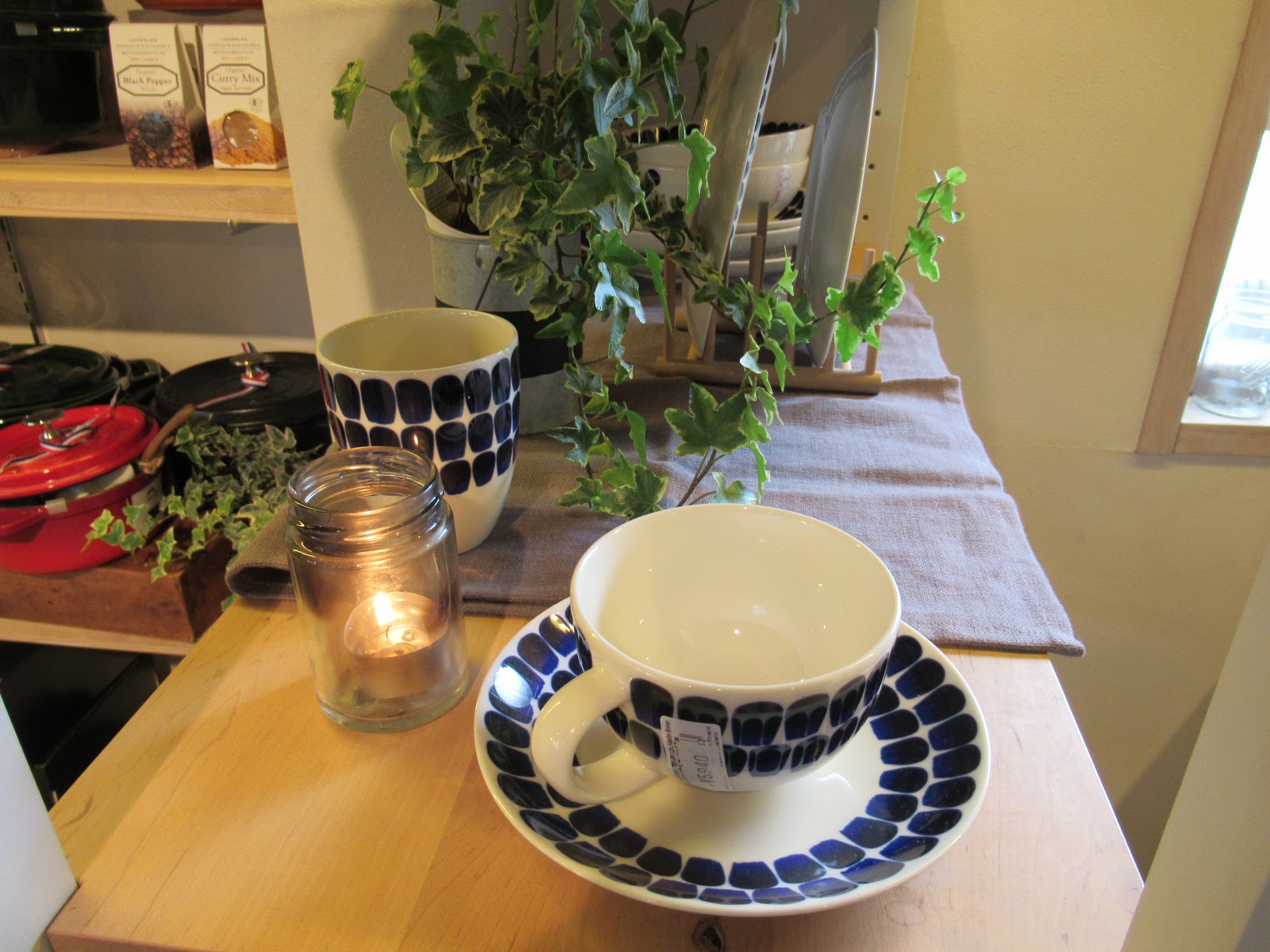
DLoFre's Campus consists of many shops mainly selling furniture, fabric, kitchenware, etc. from Northern Europe, especially Finland (I heard Finnish TV crew came to report it some years ago).  One of them is DLoFre's Interior, where I took several pictures of items that I thought very Nordic. 


These are candle stands from Sweden, I guess.


Candlelight created a cozy atmosphere.


Finnish and Swedish people love coffee. There were packs of coffee filters in a birch bark box. Birch bark crafts are traditional crafts in both countries. 


This is a Finnish Christmas ornament called “himmeli (heaven)” made of straw. 


They were also selling glass of Iittala in Finland.


Each shop had interesting goods. For example, Scandinavian Kirpputori (flea market) had ceramic cats made by Lisa Larson. She is a Swedish ceramic artist winning popularity in Japan.


These are vintage cups and saucers made by Arabia in Finland.


If you are a marimekko fan, you must visit mari&deco bar with colorful paper napkins


and Marimekko Gallery that is the only official retailer of Marimekko in Hamamatsu. In addition to these, there is a shop with 300 kinds of fabric of Marimekko and other brands.


In the premises of DLoFre's Campus, we saw very Japanese-looking houses.


This was originally a warehouse but is used as a bookstore now.


There I found a best-seller comic book in FinlandFinnish Nightmares.” It describes how a typical Finn Matti feels in certain situations, and many Japanese readers have commented on the Internet that Matti resembles Japanese people. It may be true.


Thursday, May 9, 2019

Drive to Mori-machi (4) - Shrine in ancient forest

Finally, we went to Okuni Jinja, a shinto shrine with a history of more than 1450 years. It is Enshu Ichinomiya or the highest-class shrine in western Shizuoka Prefecture. It is also said to be a “power spot” that gives visitors special energy. I felt something divine already near the parking lot, as I saw this forest in the shrine.


It was refreshing to walk along the approach to the hall of worship. This is a night light.


There was also a pond. Azaleas were in bloom.


Okuni Jinja is dedicated to Okuninushi no Mikoto. He is one of the major gods in Japanese myth and worshipped as a god of building nations, agriculture, commerce, and medicine.


The shrine had many visitors. We had to stand in line in to make a prayer.


On our way back, we found an interesting place where religion-related goods were sold. These are papier-mache dogs, which were originally made as charms for healthy growth of children, daruma dolls (modeled after the founder of Zen Buddhism), sacred sake candies, and so on.


Behind them, there were miniature torii or gateway to the sacred place, offering box, and guardian dogs. Seen from the backside, the papier-mache dogs looked like cats.


Salt is often used to purify things and places. For example, sumo wrestlers throw salt in the ring before a match because sumo was originally a shinto event to entertain gods.


One of the most remarkable things in Okuni Jinja was a stump of a sacred tree that was more than 1000 years old and fell in 1972 because of a typhoon. According to the website of the shrine, there is another sacred tree. It is about 800 years old and said to bring romance. Apart from these trees, the forest itself is very old and called an ancient forest.


In front of Okuni Jinja, there is an area called “Kotomachi Yokocho” with cafes, tea and sweet shops. It was crowded with people. Mori-machi seemed to have many kinds of products using their tea. Soon after we got out of the gate of shrine, we returned to Hamamatsu. We could see a lot of things in a day!

Wednesday, May 8, 2019

Drive to Mori-machi (3) - Amulet for gambling luck

Mori-machi is called Little Kyoto and has some quaint shrines and temples. After we visited Acty Mori, we went to Daitoin, an old temple famous for the grave of Mori-no-Ishimatsu.

Mori-no-Ishimatsu (? – 1860) is a legendary yakuza or gangster who appears in storytelling arts such as kodan and rokyoku. He was one of the 28 henchmen of Shimizu Jirocho, who was a famous gangster boss in the port town Shimizu in central Shizuoka Prefecture. According to legends, Mori-no-Ishimatsu was simple but had a lovable personality. He loved sake and had a deep sense of loyalty and was compassionate.

His grave is placed near the entrance of Daitoin, not on the premise of the temple. As Mori-no-Ishimatsu was good at gambling, there has been many visitors who cut the gravestone to keep a fragment as an amulet for gambling luck. So, they had to rebuild it. I heard that the whole second gravestone was stolen, and now they had the third one. There was also a monument of his boss Shimizu Jirocho on the right. When I visited there before, I found a little bottle of sake put in front of the gravestone. Maybe someone had won in gambling and come to thank him.


Apart from the grave of Mori-no-Ishimatsu, Daitoin had its own charm. First, we went over this red bridge.


Then, we climbed stairs.


At the end of the stairs, there was a statue of a little monk with a message “Let’s dust our mind and clean off the dirt.” He was so cute.


On the left, there was a building for trainee monks to sit in zen meditation.


This is the main hall of the temple. It was quiet as there weren’t any other visitors than us.


In front of the belfry, you can sit on a bench and take pictures


with Mori-no-Ishimatsu and Shimizu Jirocho.


Fortunately, you don’t have to cut the gravestone these days, because you can buy an amulet that contains a fracture of it in the building on the right of the main hall. In addition to a gambling luck, the amulet may bring about success in business and examinations. I had bought one before, and it really worked!

We went down the stairs to go back to the parking lot. Near the red bridge, I saw clear water and green maple leaves. In autumn, they will turn red, presenting a beautiful scenery that is worthy of the name Little Kyoto.


Tuesday, May 7, 2019

Drive to Mori-machi (2) - Tasting first tea of year

After leaving Mikuranosansou, we went back the way we had come. It was the season of the first tea of the year, and we found a tea shop serving their tea free of charge along the road. It was Ishikawaen, an old company that produces and sells green tea. They had a tent in front of their shop, with a doll of a tea-picking girl. As Mori-machi is located in a mountainous area, they have good conditions such as clean water and dense fog to produce high-quality aromatic tea.


In the tent, they were serving not only tea but also “Ochabatake (tea garden) Yokan.” Yokan is a sweet that is usually made from bean paste, sugar, and agar. In addition to these, their yokan contained green tea. We were surprised at the generosity of the shop that gave whole packed yokan to each of us.


We sat at a table and tasted. The first tea of the year had a fresh taste. It was mild and very different from ordinary tea that is sharper and bitterer. Ochabatake Yokan had a rich flavor of tea and was quite good.

In the shop, they sold a variety of tea and sweets. There was also a cast iron tea pot.


These are boxes of Ochabatake Yokan and packs of sugar-glazed beans.


They provided several kinds of gift sets as well.


My mother and sister bought some tea and sweets. Later, we could taste the first tea in the year again at home. Ishikawaen seemed to be a popular tea shop as they had many customers inside. They have also a website in English providing detailed information about their products, how to brew delicious tea, etc. If you are interested in them, search with “Ishimawaen  Mori-machi.”

Then, we went to Acty Mori. It is a large park where you can enjoy outdoor activities such as putter golf, canoeing, and cycling, as well as traditional crafts such as pottery, papermaking, and plant dyeing. It has also a restaurant and shops selling local specialties including some interesting vegan-friendly food. As we were full, we just walked around in the park to enjoy natural beauty. The riverside seemed to be a good place for a barbecue.


According to my mother, this is a chestnut tree. Without chestnuts, I could hardly recognize it.


These are irises. They are typical flowers in May.


Monday, May 6, 2019

Drive to Mori-machi (1) - Auberge Mikuranosansou

The 10-day holiday from April 27 to May 6 is almost over. During this period, I had a great time with my friends and family.

On May 3, my mother took me and my sister for a drive to Mori-machi, a town 30 km away from Hamamatsu. As the name Mori (forest) implies, it is in the mountainous area in Enshu or western Shizuoka Prefecture. Before the holiday, my mother made a reservation for lunch at Mikuranosansou, an auberge with an authentic French restaurant in Mikura in Mori-machi. When I heard this, I was worried and checked information about the restaurant on the Internet. Fortunately, I found that they can arrange the menu for vegetarians. I called the restaurant and requested a vegetarian lunch for myself.

Mikuranosansou was situated deep in the mountain, which surprised me and my sister. I wondered how you could reach the restaurant if you didn’t have a car. When we got out of the car and looked around, I somehow remembered “Heidi.” Though the mountains were much smaller than those in Switzerland, the scenery was beautiful with a tea plantation and trees.

When we entered the restaurant, there weren’t any other customers. To my relief, my request was confirmed, and I could have an ovo-vegetarian course. My mother and sister are not vegetarians, and they had the list of dishes to be served on the table. They also seemed to be a bit curious about what would be served to me. 


The first dish was salad. It contained fresh tomato, kiwi, and grapefruit beautifully arranged. In the center, there was mushroom, which may have been a local product. I was very glad to have such gorgeous salad from the beginning. 


The next dish was vegetable soup, which seemed to be common to all of us. It was full of flavor with vegetables and herbs. 


Then, we had the main dish. This is cooked potato with sauce containing dill. As I love the combination of potato and dill, which is typical in Northern Europe, it was a pleasant surprise. 


The other main dish was an omelette stuffed with rice. As soon as I saw the orangish yellow color of the omelette, I noticed that eggs used were not ordinary ones. I couldn’t help asking about it and learned that they were free range eggs.


Finally, we had the dessert. My dessert was beautiful pear compote. My mother said that it looked luxurious, and I agreed with her. It was delicious with flavor of wine. 


In addition to these, we had also bread and coffee. As a whole, the vegetarian lunch and service were very good. If you are interested in the restaurant, search with “mikuranosansou tabelog.” As an auberge, mikuranosansou may be also a pleasant place to stay at night.  


Sunday, May 5, 2019

Vegan sweets in May

Today, May 5, is a traditional festival day called Tango-no-Sekku to pray for healthy growth and success of boys. It is also my father’s birthday, and I give him sake every year. Now, it is a national holiday Children’s Day, but it is still intended for boys basically. Many families hang up koinobori or carp streamers and set out warrior dolls. According to a Chinese legend, a carp that can swim up the waterfall “Dragon Date” in the Yellow River can become a dragon. It is a symbol of success in life.

Samurai helmet and chimaki
For Tango-no-Sekku, we have two well-known sweets, kashiwamochi and chimaki. I heard the former is popular in eastern Japan and the latter in western Japan. In Hamamatsu, kashiwamochi seem to be much more common. It is a rice cake wrapped in an oak leaf and has adzuki bean paste inside. Kashiwa or an oak leaf is used to pray for the prosperity of descendants because oak leaves do not fall until the tree puts forth new leaves.


Today, I went to Mataichian in Entetsu Department Store. As it is a popular confectionary shop, there was a queue of customers to buy sweets for this festival day. They were selling three kinds of kashiwamochi. I chose a green rice cake with mugwort in it, stuffed with chunky bean paste. Unlike the cherry leaf of sakuramochi, this leaf is not edible, I guess.


Like other sweets of Mataichian, the bean paste is very good. The flavor of mugwort was moderate. The other two types are a white rice cake with smooth bean paste and a pink rice cake with white bean paste with miso added. According to their website, the pink one has many hidden fans. I must try it at some other time.

Two days ago, I went to my parents’ house, and my sister gave me sasadango or bamboo dumplings, a specialty of Niigata Prefecture. According to some websites, they eat them for celebration of tango-no-sekku. I liked the unique shape of sasadango that reminded me of a candy. Each of them was wrapped with several bamboo leaves.


Sasadango was dark green and reminded me of a green tea candy, however, it was the color of mugwort. As in the case of kusamochi in Doll’s Festival in March, mugwort is used to drive away evil spirits. The flavor of mugwort in this dumpling was strong, and it tasted somewhat bitter. It surely had some power. Bamboo leaves are also considered to be a protector against evil.


The dumpling was stuffed with adzuki bean paste. As Niigata Prefecture is known as a rich rice-producing area, they have good ingredients also for traditional sweets such as dumplings and rice crackers, and for sake.

Friday, May 3, 2019

Moomin sweets in Roppongi Hills

Yesterday, I went to Tokyo to see my friends from university. At first, I didn’t intend to write any article about this trip or take pictures, because I just wanted to talk with them to have a good time. I met them for the first time in 13 years.

We met up in front of the statue of Hachiko, the landmark of Shibuya Station at 11:30. Then, we went to a vegetarian Indian restaurant Milan Nataraji, 5-minute walk from the station. There we had a buffet with naan bread, rice, four kinds of curry, salad, dessert, etc. I think I’ll write about this restaurant in detail some other time. Their food was good, and the atmosphere was agreeable.

After that, we returned to Shibuya Station and took a bus (Line 51) to Roppongi Hills. They have an exhibition of original drawings of Moomintroll series by Tove Jansson in Mori Arts Center Gallery on the 52nd floor until June 16. As Moomintroll is very popular in Japan, there were great many visitors. We had to wait for 30 minutes before we could enter the venue.

This exhibition is one of the memorial events for the 100th anniversary of the establishment of diplomatic relations between Finland and Japan. It was the most fulfilling collection of Moomin drawings I had ever seen, and so was the souvenir shop. There were many Moomin goods that were available only there.

On the same floor, there was “Cafe THE SUN” providing Moomin menu. There, each of us ordered different menu items. One of my friends had “Parfait of Little My.”


The other friend ordered “Moomin Valley Plate.”


I had “Moomin Fika Set” just because I wanted to eat the cinnamon roll included in the set.


According to my friends, the sweets they had were very sweet, but they were colorful and beautifully made. The set I had was moderately sweet and quite satisfactory. All of us took pictures of each of them.

On the table, there were paper coasters that also serve as discount coupon for the exhibition. It’s a pity that we went to the exhibition first!


Happy New Year of Ox 2021

If you are in Japan during the year-end and New Year holidays, you can see many pretty sweets at Japanese confectionary stores. As 2021 is t...