Sunday, May 19, 2019

Hamanako Garden Park (2) - International Garden

When the international event was held in 2004, gardens of different countries were made in the park. Even now, you can see many of them in the area “International Garden.” The first one is the Nepalese garden.


This is the inside of the garden. The greenery matched the color of the building well.


In this area, the buildings and the objects were sometimes more interesting than the plants. In front of the Indonesian garden, there were two stone statues. I wondered what they represented.


This is the Korean garden. On the top of the gate, I saw characters “友好之門“ that mean the “gate of friendship.”


The garden had a big ying-yang mark in front of an arbor. It reminded me of the national flag of Korea and the Chinese martial art tai chi.


There is also a garden of China. Many years ago, I took a picture of it on April 1 and sent it to my sister, saying “Now I’m in China.” The whole garden is so well made.


When you enter from this round gate,


you see an arbor and a pond on the right.


When I was in the arbor, a visitor standing next to me was feeding the carps.


On the opposite side, there is another arbor.


The waterside view is also nice.


In the English-style garden, there were more flowers.


Roses had a fragrant scent.


Another impressive western-style garden was that of Toscana, Italy.


The bushes were neatly trimmed.


I climbed up the stairs to have a better view over garden.


It was made symmetrically and beautiful.


Saturday, May 18, 2019

Hamanako Garden Park (1) - Lakeside marvelous park

Hamanako Garden Park is one of my favorite spots in Hamamatsu. It is a huge park with an area of 56 ha. It was originally made for an event “Pacific Flora 2004,” Shizuoka International Garden and Horticulture Exhibition. After that, it has been an admisson-free prefectural park where you can see many kinds of flowers and relax. Now, Hamanako Garden Park is one of the two parks where Lake Hamana Flower Festa 2019 is held (the other is Hamamatsu Flower Park), but it remains admission-free.

The only disadvantage of this park is that public transportation is inconvenient. Even on weekends, there are only 6 buses a day from the bus terminal behind JR Hamamatsu Station to the park (it takes about one hour). During Lake Hamana Flower Festa 2019, there are 3 buses a day from JR Maisaka Station, but it is still inconvenient.

This morning, I took a train to JR Bentenjima Station. It was only 12-minute ride from JR Hamamatsu Station. Bentenjima is a little island on Lake Hamana connected with the sea, and the sea is just 2 km away from the station. From the exit, I went to the north side of the station, hoping that the weather would become better.


Then I continued to walk northward then on a long bridge Hamanako Ohashi. As Lake Hamana is connected with the sea, it was windy on the bridge and the air smelled salty. I love it. That’s why I walked to Hamanako Garden Park instead of taking a bus. The observatory tower in the park was visible all the time, but it took me 45 minutes to get to the park.


The first thing I saw in the park was a huge lawn field. On the right of it, there was a parking lot.


The first garden area of the park consists of flower beds owned by local groups such as schools, families, companies, or other organization. They are volunteers of this park and work with their own flower beds by planting, watering, etc. Today, the groups had taken their flowers to plant to their  flower beds. I saw some volunteer people working there.


Each flower bed had a board with its owner’s name.


The combination with an old bench and bricks was nice.


This was colorful.


Behind these flower beds of groups, there were larger flower beds. The brown building over there is a stage where concerts are held sometimes.


In this park, gardens are placed along a waterway. Beyond it, I saw the obervatory tower with a height of 50m. I have never been to the top, but the view over the park and Lake Hamana may be splended.


Monday, May 13, 2019

Hamamatsu Festival (3) - Gorgeous palace floats

I came back to downtown from the kite field around 16:00. I saw some floats on the main street Kaji-machi Dori. They are called Goten Yatai, which means a palace float. But they originate from carts used to carry kites to the kite field. Now they are decorated with fine wood carvings and lanterns.


During the festival, floats like these were drawn on this street from 18:30 to 21:00. This year, about 81 neighborhoods participated in it with their float. On the previous day, May 4, I took some pictures of them at night. The lanterns were lit, and there were girls and women sitting inside and playing the drum, flute, and shamisen. In many cases, such music groups mainly consist of elementary school girls.


There came floats one after another, with people from respective neighborhood. With lanterns lit, they looked so gorgeous. On the other side of the street, they could see floats going to the opposite direction. As this was the float of a neighborhood that located west of downtown, it went westward.


Usually, the melodies played in the floats are those of traditional short songs. You can hear it by searching with “Hamamatsu Festival night” in YouTube, for example. At the same time, you may also hear a distinctive melody played by buglers around the floats. This unusual mixture of sound is one of the uniqueness of Hamamatsu Festival. With the bugle melody, people jostle each other, becoming more and more excited. Hamamatsu Festival is a festival of the people, by the people, for the people. Participants enjoy themselves all day long for three days.

Sunday, May 12, 2019

Hamamatsu Festival (2) - 100 yen vegan sweet & Festival Pavilion

On the south side of the kite field, there were many stalls selling snacks. One of them sold warabimochi, a jelly-like sweet made from bracken starch. It is good to eat especially in summer, but it is available in any supermarket all year round. I got curious because it was rather unusual to find a warabimochi stall in a festival or event.


When I came to the stall to check the prices of packs in different sizes, they said to me that if I wanted to eat at the kite field, it was recommended to buy warabimochi sold for 100 yen. I wondered why it was so inexpensive but paid 100 yen. It was a kind of lottery. I pulled the knob attached to the box to turn the round plate with numbers and took off the hand. After a while, the needle showed 30, and I got 30 pieces of warabimochi.


They had much toasted soybean flour on them. I was very glad to have so many warabimochi with just one coin. They were soft and jiggly. It was also enjoyable to go in for lottery.


After eating them up, I went up to the dike behind the row of stalls. On the south side, I saw the sea.


On the north side, I could see the kite field very well.


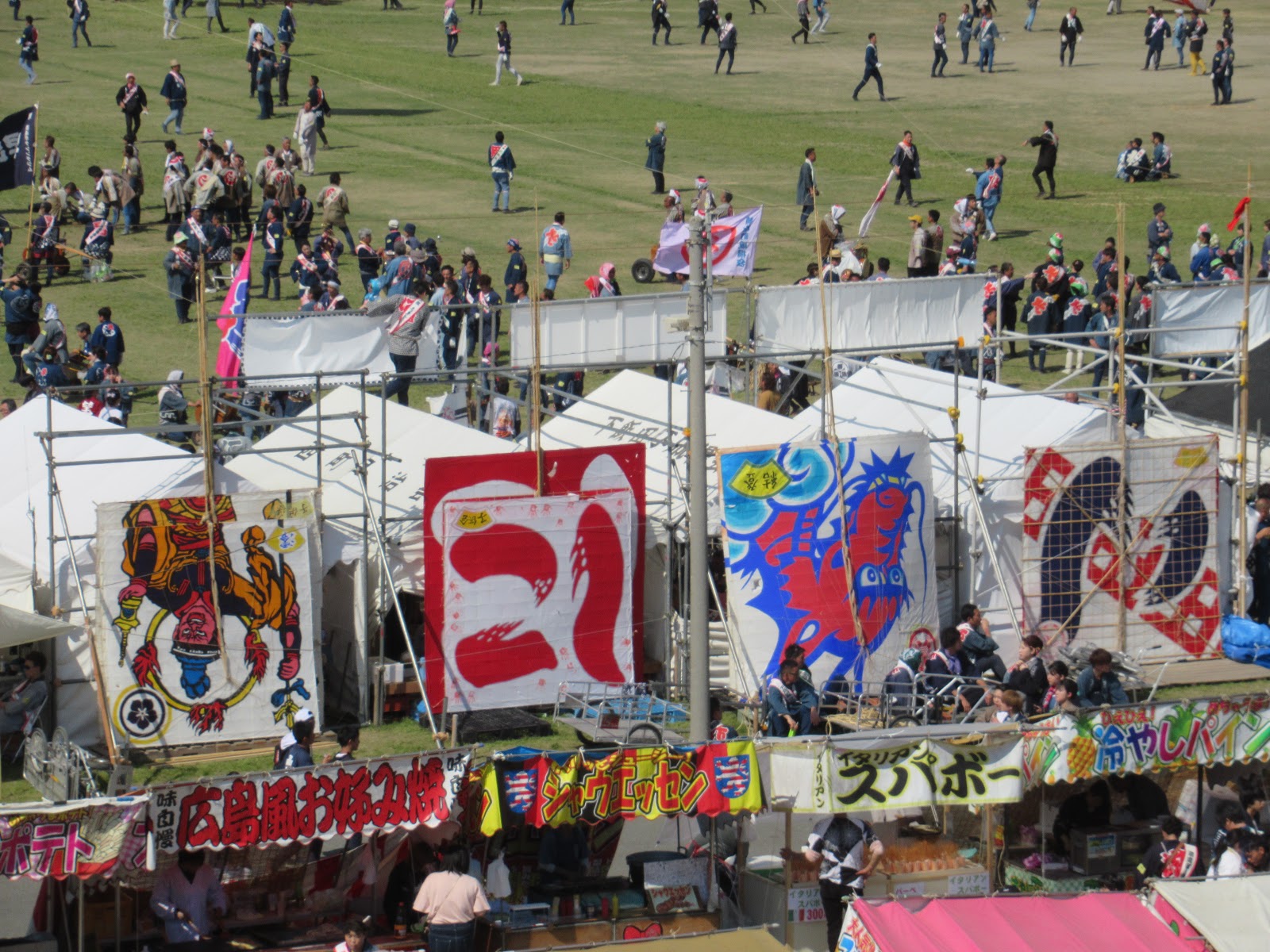
Each neighborhood had their own tent, behind which they had kites for firstborn children upside down. The kites had the names of the children written at the bottom.


When zooming in, I noticed Act City seen clearly.


Then, I left the kite field. On my way back, I looked again the sand dunes by the sea. Nakatajima Sand Dunes are one of the three largest sand dunes in Japan.


During the festival, you can enter Hamamatsu Festival Pavilion near the bus stop at half the price if you show the ticket of the shuttle bus. As I had bought a round-trip ticket, I entered the pavilion for 200 yen.


If you want to see kites closer, this place is highly recommended.


These are festival costumes called happi. Each neighborhood has their happi that bears the same mark as their kite.


In the souvenir shop, there were miniature kites that you can fly by yourself.


This pavilion provides detailed information in English as well. If you are interested in it, search with “Hamamatsu Festival Pavilion.” It is open all year round, except for December 29 to 31. Even if it rains during the festival and kite flying is canceled, you can still see kites there.

Hamamatsu Festival (1) - At kite field

During the 10-day holiday, we had Hamamatsu Festival from May 3 to 5. It originated about 450 years ago when a big kite was flown to celebrate the birth of the firstborn son of the lord of Hikuma Castle (a castle that existed before Hamamatsu Castle). One of the main features of Hamamatsu Festival is kite-flying battles that take place by Nakagajima Sand Dunes.


On May 5, I went to the kite field by a direct shuttle bus that left from near Act City. It took about 15 minutes to get to the bus stop near Hamamatsu Festival Pavilion. From there, I walked about 10 minutes to the kite field. This year, there were more than 170 neighborhoods participating in kite flying. Each neighborhood had its own kite with a large mark painted on it. When I got there, they were just flying kites, and I couldn’t see any battles in which people tried to cut the thread of a kite of other neighborhood by friction. For visitors who didn’t wear the traditional costume for the festival, spectators’ seats were provided free of charge. So, I took a seat to watch kites easily.

In the festival, children also play an important role. In addition to battles, each neighborhood fly hatsudako or first kites to celebrate the births of firstborn children. Previously, it was done for only firstborn sons, but these days, many parents prepare kites even for their daughters. Since Hamamatsu Festival is not a religious festival, it may be easy to make changes flexibly according to the times.

While I was sitting on the seat, a neighborhood group came and stopped in front of us. They welcomed spectators by playing the bugle. In the festival, children performed actively as buglers who set the mood for the festival.


In front of us, there was another neighborhood group trying many times to fly their kite. It was exciting to see the kite flying rapidly into the air. But it fell soon. It was difficult to take a picture of a flying kite, so I left the spectator seat to go to the opposite side of the field.


Flying kites looked like living things, with their long tails moving in the wind.


And how I wished I was a good photographer to show such kites as they were!


Friday, May 10, 2019

DLoFre's Campus (2) - Café with great popularity

After my sister took a number at DLoFre's Cafe, we strolled around in DLoFre's Campus nearly for two hours. Since there were many things to see, it was not so hard to kill time. Sometimes my sister checked her smartphone to see how many were still waiting before us, and we finally returned to DLoFre's Cafe to wait inside.


We read the menu while waiting. They had pancakes, galettes, pasta, etc. for main dishes. After we were guided to a table, I asked a staff member if soya milk cottage cheese & basil romagna was animal-free. She said that all their spaghetti contains egg, so it was an ovo-vegetarian dish. I ordered it and a set of drink and mini dessert. Other people also ordered the same set in addition to their main dish.

Then, I went to fetch some water. Unlike ordinary restaurants in Japan, they had water with rosemary, mint, and lime respectively. I had a glass of water with mint. It was refreshing, so I brought another glass to my mother.


First, we had the drink. I chose pineapple juice.


This juice was thick and good. My mother said that her orange juice was also thick. According to the staff member, they use straws made of paper. They may be much better than plastic ones that are harmful for the environment.

This is soya milk cottage cheese & basil romagna. It was spaghetti with tomato sauce. The soya milk cottage cheese had a taste that was as rich as real cottage cheese. The spaghetti was al dente, moderately cooked.


While we were eating, my sister’s husband gave each of us a piece of his pancakes to taste. Like galettes that my mother and sister were eating, it seemed to be made from buckwheat. But it was spicy and had an interesting taste. As an additional option, it is possible to order a pancake, so maybe I’ll have one next time.

Then our desserts were served. As it was not selectable, all of us had the same ones. Though none of us knew exactly what the right one was, we thought it good. I checked the menu later on the Internet. Maybe it was bavarois with banana and avocado, and the other was Italian fruit salad macedonia.


The lunch was of high quality, and we said to each other that the restaurant surely had an excellent chef. I remembered my friends with whom I had Moomin sweets together on May 2 and wished that I could come to DLoFre's Cafe again with them someday.


DLoFre’s Cafe
Address: 2858 Miyakoda-cho, Kita-ku, Hamamatsu-shi, Shizuoka Prefecture
Tel: 053-525-9001
Open hours: 11:00 - 18:00
Closed: Tuesdays and Wednesdays
Access: 15-minute walk from Miyakoda Station (Tenryu Hamanako Line)

Happy New Year of Ox 2021

If you are in Japan during the year-end and New Year holidays, you can see many pretty sweets at Japanese confectionary stores. As 2021 is t...