Thursday, March 19, 2020

Healthy fermented foods (4) - Amazake nicknamed “drinkable IV shot”

Amazake literally means sweet sake, but it is a low or non-alcohol fermented rice drink. You can drink hot amazake at some sightseeing spots and events, and it tastes especially good in winter. However, cold amazake is available at any supermarkets all year round. It is often packed in a bag, but some products are packed in cartons. This one is available in Seijo Ishii in the basement of the station building.


Amazake has two types with different ingredients. This non-alcohol type is made from rice, rice malt, and salt. Though it doesn’t contain sugar, it is sweet. It is high in nutrition containing vitamins B1, B2, B6, folic acid, fiber, oligosaccharide, essential amino acids, glucose, etc. and is called drinkable IV shot. I heard people used to drink amazake to prevent summer heat fatigue during the Edo period. Nowadays amazake is often considered to be a drink in winter, and I seldom drink it in summer. But I found this amazake delicious whether it is cold or warm. Maybe I’ll continue to drink it even in summer.

The other type of amazake is made from sake lees, sugar, and salt. So, it contains a little alcohol. Though you can drink this type in some events at a reasonable price, you can make it easily by melting sake lees in hot water and adding some sugar and a little salt. This type of amazake warms you up in winter.

Amazake can be used also for cooking. The other day, I mixed it with miso with a ratio of 1:1 to make sauce. Miso is paste made from fermented soybeans, to which rice or barley is added sometimes. Different regions have different kinds of miso, and this time I used one from Niigata Prefecture famous for its rice cultivation. It contained soybeans, rice, salt, and alcohol. It smelled nice and was salty. Even after mixed with amazake, it didn’t become very sweet.


Then, I soaked a piece of tempeh or fermented soybeans into it.


After grilling, I ate it with German rye bread and sauerkraut. This open sandwich has four kinds of fermented foods: sauerkraut, tempeh, amazake, and miso.


I found this combination was not so good as I had expected because the bread, sauerkraut, and sauce had a distinctive taste respectively. It’s better to eat the tempeh separately. However, the sauce matched the grilled tempeh, and it may be suitable for many other foods with a mild taste.

Saturday, March 14, 2020

Healthy fermented foods (3) - Sauerkraut from Germany

I like German ryebread very much and have once introduced it in this blog as an emergency food for a disaster as it keeps for a long time. It is sour and rich in nutrition. Recently, I often eat another German food that is also sour and nutritious. It is sauerkraut or sour cabbage. According to Wikipedia, it is fermented by various lactic acid bacteria and is a high source of vitamins C and K.

I found this bottle in Meidi-ya in the basement of Entetsu Department Store. The ingredients are only two: cabbage and salt. It must be a real traditional type.


At first, I was worried to find that the lid was too tight to open. I held the bottle upside down and soaked the lid in hot water in a pot for a while. It worked, and I finally managed to open it. The bottle was filled with cabbage up to the brim!


Sauerkraut is finely cut, pale, sour, and juicy. It’s totally different from green crispy raw cabbage I know. When I ate sauerkraut for the first time, I was surprised to learn that raw cabbage can become so soft. I eat it with German ryebread sometimes. As both of them are sour, maybe some other tastes should be added.


Sauerkraut can be used also in soup. This soup contains sauerkraut, tomato, dried daikon radish, broccoli, potato, onion, carrot, and a pinch of salt. It was just mixture of vegetables in the refrigerator. When I took this picture, I noticed the smell of sauerkraut. It increased my appetite.


As tomato is also sour, I wasn’t sure how much sourness came from sauerkraut. But the soup was tastier than tomato soup I made before without sauerkraut. Even if you think sauerkraut is too sour and is not very delicious, you can use it in soup or other dishes to add an extra flavor. But I prefer eating it raw. It has a kind of addictive taste, and it won’t take long before the bottle gets empty.

Thursday, March 12, 2020

Healthy fermented foods (2) - Tempeh made in Japan

I think traditional cuisines in the world often include fermented fooods. In addition to natto, there is another kind of fermented soybeans available in Japan. It is tempeh (or tempe), which was originated from Indonesia. In Hamamatsu, you can eat fried tempeh in an Asian restaurant Garuda in the downtown. Last summer, I had this Tempe Goreng with sweet sauce.


Even in some supermarkets, there are some tempeh sold near tofu and other soy products. But I found them quite expensive compared with Japanese soy products. In addition, you have to keep them in a refrigerator, so, it is much more convenient to buy them via Amazon Japan. They sell a set of 10 packs that costs 2,460 yen, and the tempeh (100g) is in a retort pouch to be kept in a room temperature. The outer bag has some pictures to show how to eat it. It can be used in salad as it is, cooked with hijiki seaweed, and included in a pizza, for example.


This is one half of tempeh, which has a weight (50g) similar to that of one typical portion of natto (40 - 50g). Unlike natto, it is a cake of fermented soybeans and isn’t sticky at all.


I often saute it and eat with soy sauce and grated ginger as it may be one of the simplest ways to eat it.


The next one is also easy to make. You only need to chop tempeh, eggplant, and tomato and saute them together, add some salt, and sprinkle dried parsley. As tempeh has just a mild taste of beans, it is easy to use with other ingredients.


Personally, I like tempeh better than natto though it is more expensive. Even among Japanese people, there may be those who have difficulty getting used to the flavor of natto (like me) though they want to eat nutritious foods. For them, tempe may become the best alternative if it will be more advertised and the price will be less expensive. As with natto, tempeh features GABA, isoflavone, and fiber (according to the description on the bag) and can regulate the functions of the intestines.

Tuesday, March 10, 2020

Healthy fermented foods (1) - Trying to eat natto

The middle of March may be the worst season for those allergic to pollen. In Hamamatsu, there are many cider and Japanese cypress (hinoki) trees in the mountainous area, which were originally planted for a flood control project for Tenryu River east of the city during the Meiji period (1868-1912). Now they are used as high-quality timber, but there are also people allergic to them.

One of my cousins used to suffer from allergy in spring. Several years ago, he said his pollen allergy got better while he ate natto every day. Natto is fermented soybeans and may be considered one of the strangest foods in Japan. Since this is my cousin’s personal experience, I’m not sure if natto can help other people to improve their allergy. But at least, fermented foods are said to be good for our health. So, recently, I have been trying to eat them, especially natto, as often as possible. In Hamamatsu, we ate it neither at home nor at school when I was little. For me, it was like an exotic food that I tried to eat when I traveled to other regions in Japan and stayed at Japanese-style hotels. Even now I don’t really like it, but I have become more health conscious because of the coronavirus.

This is natto I usually buy in the basement of JR Hamamatsu Station. Natto is often sold with three packs at a reasonable price.


It is often accompanied with sauce and mustard. As with natto of other manufacturers, the sauce contains dried bonito broth. So, I use just mustard.


Natto looks like this when the wrap is removed.


Then, it is stirred with chopsticks to become stickier. I heard this stickiness is good for our body, but…


Usually, I also add soy sauce. It is bitter, and I have never thought it is delicious. But natto is highly nutritious, containing protein, vitamin B6, kalium, magnesium, iron, vitamin E, calcium, vitamin B2, and fiber. According to some websites, it can regulate the functions of the intestines and improve immune strength. It may be important to prevent diseases such as cold, influenza, and other infections.

Sunday, March 1, 2020

Hina-dolls in Kasuisai Temple

The Doll Festival is coming soon. It is held on March 3 every year to pray for healthy growth of girls with a set of hina-dolls displayed at home. The most typical set consists of the imperial pair, three court ladies, five musicians, two guardians, three servants, furniture, etc. When a daughter born in a family, it is often the girl’s grandparents on mother’s side who present her with such dolls. But it depends on families.

In addition to families, many museums and sightseeing spots have exhibitions of hina-dolls at this time of year. Kasuisai Temple in Fukuroi (about 17-minute train ride from Hamamatsu) has one of the largest collections of hina-dolls in Japan. Their exhibition started from the beginning of January, and now they have some other interesting things to see. Last week, I visited there and had a very good time.

It takes about 40 minutes from JR Fukuroi Station to Kasuisai Temple on foot. This time I could take a bus immediately after arriving at the station, though there is only one bus an hour. It took about 10 minutes to get to the bus stop “Entrance of Kasuisai.” The first hina-dolls I saw were those sitting on the stone stairs to the temple. Though I had heard about it before, I was surprised at the sight.


Along the corridors of the temple, there were dolls of imperial pairs.


Some of them had gorgeous hair ornaments.


Some were enjoying tea.


This is a princess from a Japanese classic “The Tale of Genji.”


Court ladies were also elegant.


I liked this comical doll of a servant.


They looked cute with pink and white rice cakes in front of them.


The highlight of the exhibition is these 1,200 dolls on 32 steps. It was awesome. The room itself was splendid with the beautiful design of the ceiling.


On the opposite side of the room, ceremonial kimono in actual size were displayed. The women’s kimono has twelve layers. I imagined it was heavy to wear.


The men’s kimono is much simpler.


This is a set of traditional hanging lucky charms called “Kasafuku (literally means umbrella luck)” from Sakata in Yamagata Prefecture. There are as many as 999 pieces and made by 12 people.


Turtles for a long life, gourds for good health, balls, patchworks, etc. They were so colorful.


Even the garden of the temple had a festive atmosphere. They had dolls outside as well. There are five musicians.


A knight on a white horse like in European folktales?


I think this pair may be the most romantic of all. It looked like a scene from a love story.


You may wonder why a temple has so many hina-dolls or where the dolls came from. As I explained, girls were given hina-dolls when they were born. After they have grown up, the role of the dolls for protecting the girls is over. They are brought to a temple or shrine for a memorial service and burned there. Many people treat their hina-dolls carefully as if they had souls and don’t dare to discard them directly. The dolls in Kasuisai Temple may have been such dolls. Each of them had its individual characteristics and a presence.

Until March 15, Kasuisai Temple provides a special vegetarian set for the Doll Festival. It should be reserved by more than one person in advance. It costs 3000 yen and more expensive than other seasonal sets. I couldn’t eat it, but they will have Peony Festival in their peony garden from April to May, and I think they will have another seasonal set then. Even now, they have an indoor peony exhibition, but the flowers were less beautiful than before. So, I’ll show you a picture taken in January. Kasuisai Temple is a great culture spot with events and beautiful interior decoration of the temple itself.


Saturday, February 29, 2020

Traditional homemade dishes in vegan box lunch

Two days ago, Japanese prime minister Shinzo Abe requested nationwide school-closure from March 2 to protect children from being infected by the coronavirus. In Hamamatsu, all the municipal elementary schools, junior high schools and senior high school will be closed from March 3 to March 15. The students will basically stay at home.

Last weekend, I participated in a walking event held by JR Central. But after that they cancelled all their walking events planned to be held on weekends until March 15. Even local events in Hamamatsu such as concerts, sport competitions, and lectures are cancelled. Maybe I will mostly stay at home until the middle of March. Though I have still some masks, it is very difficult to find them at stores now. I think I’ll make one with a handkerchief if necessary. When you search with “handkerchief mask” in youtube, you can see several videos showing how to make a mask without cutting and sewing cloth.

Today, I bought a vegan box lunch at Entetsu Department Store. As its contents change from day to day except for the brown rice accompanying with the vegetables, they were different from those I introduced in January. Today’s box contained two traditional homemade dishes. One was simmered daikon radish with sweet miso sauce. This sauce was dark brown and had a strong taste, which is typical of this dish. The other was canola flowers dressed with mustard, vinegar and miso. It was a bit bitter and had the flavor of a citrus fruit. At first, I thought it was yuzu, which is often used for it. According to the label, it was orange vinegar that I had never heard of before.


The box also contained potato fried with spice, chickpeas and carrot fried with cumin, and shiitake mushroom grilled with basil (and bread crumbs). These were their original dishes and not traditional ones. I found the combination of shiitake mushroom and basil very interesting. I had thought a shiitake mushroom was a typical ingredient for Japanese and Chinese dishes. But it can be also combined with a western herb. The thick pieces of mushroom were filling and might be satisfactory even for those who aren’t vegetarians/vegans.

Wednesday, February 26, 2020

Sawayaka Walking in Shimada (2) - Delicious sweets in downtown

Near Shimada City Museum, there is an area that was a base of river-crossing during the Edo period and crowded with travelers and local people. The streetscape at that time is rebuilt and looks like an outdoor museum. Last Sunday, they had an event “Japanese Sweet Bar” where local confectionary stores were selling their sweets in old-style houses. When I got there, some houses were full of people, and popular sweets seemed to have been already sold out.


I was disappointed but continued to walk toward the downtown. On my way there, I visited Oi Shrine with a big stone lantern in front of the gate. It was donated by express messengers working between Edo - Kyoto - Osaka in 1856 to pray for safety during their travel and crossing of Oi River.


The premises were spacious and comfortable.


In the downtown, they had an open-air market with local vegetables,


and some snacks. In a stall, they were grilling dumplings.


Customers could choose their favorite sauce. The person in front of me chose sweet soy sauce.


I chose sesame sauce. Warm soft dumplings with thick savory sauce may be one of the most delicious vegan sweets in Japan.


It was a fine but windy day. Windmills sold on another stand were rotating nearly all the time.


In Shimada, you can find Japanese-style confectionary stores relatively easily. In the course of the walking, there were two big stores. One of them was Ryugetsudo where I bought ko-manju, which literally means a small manju or bun.


In the 18th century, Fumaiko, the feudal lord of Matsue (Shimane Prefecture), who was known as a person with refined taste, stayed in Shimada during his travel on the Tokaido Highway and ate a bun of a confectionary store Shimizuya. Then he advised that they should make their buns bite-sized. After that ko-manju or small bun won popularity and became a specialty of Shimada.


As they looked just ordinary buns, I bought only one to taste. They kindly brought me a newly steamed bun that was still warm. Though it was only 40 yen, it was very delicious with flavor of sake. Then I realized why it has been loved by so long time. It is not just a small bun with adzuki bean paste inside.

On the same street, there was another big confectionary store Nakamura Kashiho.


There I found instant adzuki bean soup.


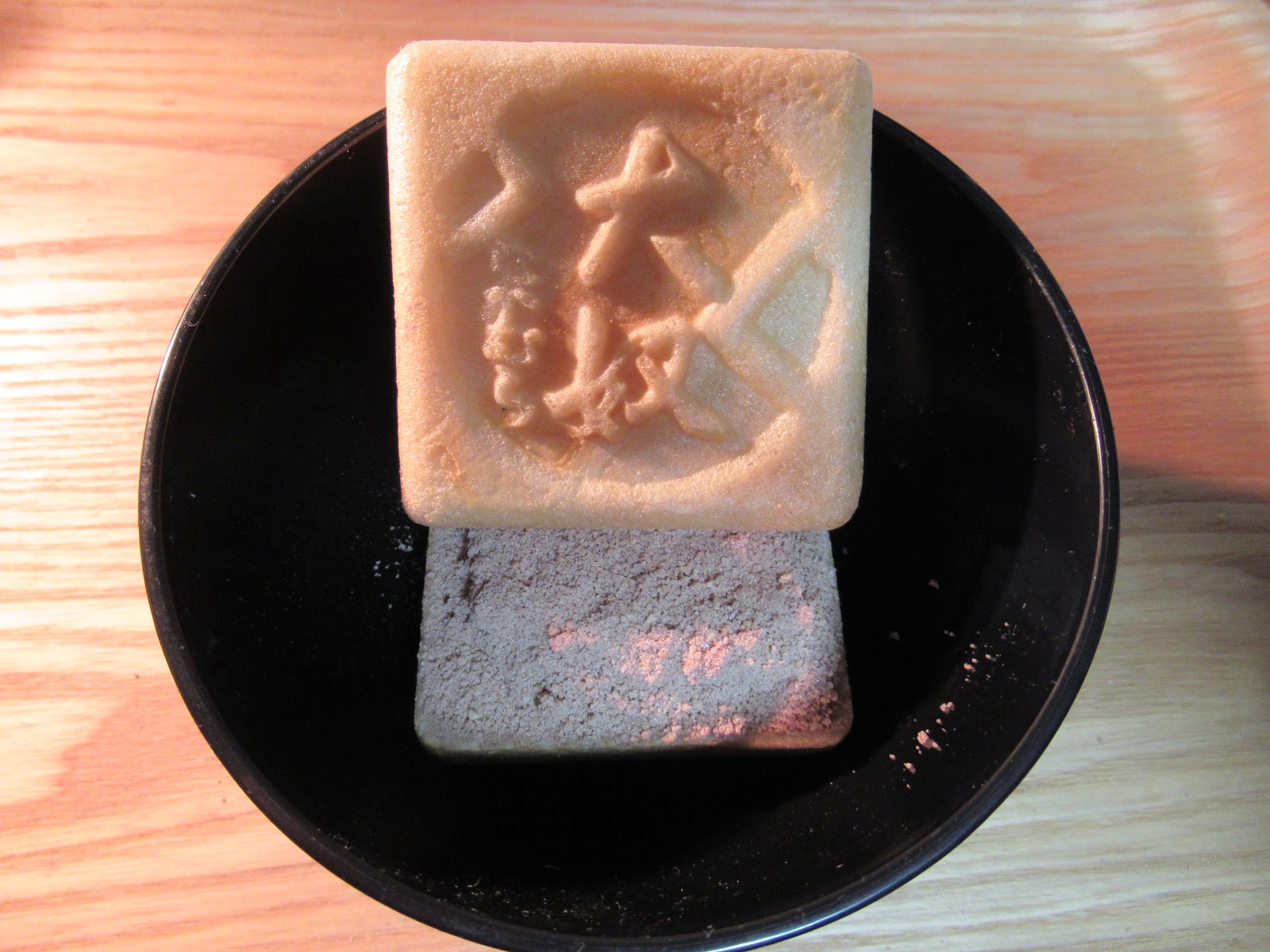
It was a box filled with powder. The ingredients are adzuki beans, sugar, wasanbon-to sugar, starch, glutinous rice, and salt. I had thought the box was made from wheat flour, but it wasn’t included in the ingredients.


When I poured hot water into the bowl, the soup looked like this.


The box was softened and melted in my mouth. The soup wasn’t too sweet and warmed me up. After eating it up, even my fingertips got a little warmer. It may become a nice gift or souvenir when it is cold.

In front of Shimada Station, there is a statue of Eisai (1141-1215). He was a Buddhist monk who studied in China and was inspired by the tea culture there. After returning to Japan, he promoted cultivation of tea. With the Meiji Restoration in 1868, the vassals of the last shogun Tokugawa Yoshinobu lost their job and started cultivation of Makinohara Plateau (a part of Shimada, Makinohara, and Kikugawa) to have tea plantation. People who were engaged in carrying travelers across Oi River also joined in it after the river-crossing system was abolished in 1870. Now, Makinohara is the largest tea production area in Japan. I think this is one of the reasons why Shimada has very nice Japanese-style confectionary stores in the downtown even today, because green tea goes well with traditional sweets.


Happy New Year of Ox 2021

If you are in Japan during the year-end and New Year holidays, you can see many pretty sweets at Japanese confectionary stores. As 2021 is t...