From Futaba Museum, I walked to Takaoka Station and took a subway (Sakura-dori Line of Nagoya Municipal Subway) to Nagoya Station. I had been looking forward to having a lunch in Nagoya because there is a south Indian restaurant near the station. In Japan, there are many Indian restaurants, so it isn’t difficult to find one in provincial cities like Hamamatsu. But most of them serve north Indian dishes, featuring big naan bread. You can find south Indian restaurants only in big cities including Nagoya.
The restaurant ERICK SOUTH was easy to find. It was in the basement of KITTE NAGOYA, a shopping mall that was 5-minute walk from the station. When I got there, I saw about ten people waiting in front of the restaurant to be seated though it was around 13:30. It seemed to be very popular. After a while, I was guided to a long table and could have a seat. Their menu was very convenient for vegetarians because ERICK SOUTH uses the Indian vegetarian mark (a green circle in a green square) to distinguish vegetarian dishes from other dishes. I ordered Veg Meals with full of expectation.
The menu items were also written in English. While waiting, I read the menu carefully and found that Veg Meals can be changed to be a vegan version with an extra charge. If I have another chance to come there, I’d like to try the vegan version. But it was still exciting to have a standard Veg meals as I had seldom eaten south Indian dishes. It looked gorgeous! It included turmeric rice, coconut curry, Aloo Baigun, Daal Tarka, sambar, rasam, yogurt, vada, upma, coconut chutney, papad,
and Basmati rice under papad.
Like me, many Japanese people who aren’t familiarized with meals would be surprised to see this variety of dishes and wonder what they are. So, the restaurant had a sheet on every table to provide the names and description of respective dishes and explain how to eat meals.
I started with papad. According to the explanation, it was made from ground beans. I broke it in some pieces and ate as they were. Papad was crispy and reminded me of potato chips. But it wasn’t oily at all and seemed to be much healthier. It was a little salty and seemed to be good for snack.
Then I tasted the coconut curry. Though it is my favorite kind of curry, I had eaten it only in a Sri Lanka restaurant (it is also in Nagoya). As I had expected, it was mild and very good. Though the instruction recommended mixing curry and rice on the tray, I ate curry and rice separately just because I wanted to taste them separately. Basmati rice was served with some chickpea powder on top. On the table there were pickles and chickpea powder in cans so that customers could add them freely to their dishes. According to the menu, Aloo Baigun and Daal Tarka were the vegetarian dishes of the day. Aloo Baigun was thick curry with eggplant and potatoes. Daal Tarka contained four beans boiled to a pulp. Like other bean curry I had eaten before, this Daal Tarka was very tasty. I noticed that we seldom use multiple kinds of beans together in traditional Japanese dishes. Why?
Sambar and rasam are soup. According to the explanation, sambar contains toor dal and vegetables, and rasam is spicy soup with flavors of tamarind and black pepper. As both of them were red, they looked very hot. Actually, they were quite spicy, but I was very glad to eat them. Several years ago, I traveled to North India. Then I had a lunch in a South Indian restaurant in Agra and ate these soups with rice. They had strong but good tastes and somehow reminded me of rice and miso soup that is the basic combination in a traditional home cooked meal in Japan. It was one of my most impressive experiences in India.
Vada is a kind of doughnut made from urad dal. In fact, I couldn’t remember exactly how it tasted because of the stronger flavor of coconut chutney. I liked it very much. This sauce was also on upma made from rough-ground wheat flour mixed with vegetables and spices. It had an elastic interesting texture.
The restaurant provides free refills of sambar, rasam, and the two kinds of rice, but I was quite full when I finished the meals. Sambar and rasam were so spicy that my lips and inside of my mouth were tingling even after eating sour yogurt and drinking water. So, I ordered Navratan Kulfi and chai to mitigate tingling.
The taste of chai varies greatly depending on restaurants. This chai was relatively sweet. Navratan Kulfi was a dessert made from strained yogurt, dried fruits, and chocolate. It was frozen and difficult to cut with the fork but very delicious! (However, I noticed later that Navratan Kulfi on the menu didn’t have a vegetarian mark. Staff members in the restaurant seemed to be very busy so I couldn’t ask them why)
When I left ERICK SOUTH, there was no one who was waiting outside to have a seat. So, I could take a picture of the restaurant finally. I hope we can have this kind of restaurant in Hamamatsu someday.
ERICK SOUTH
Address: B1F, JP Tower Nagoya (KITTE NAGOYA), 1-1-1 Meieki, Nakamura-ku, Nagoya-shi, Aichi
Tel: 052-433-1780
Open hours: 11:00 - 23:00
Closed: According to KITTE NAGOYA
Introduction of Delicious Food, Restaurants, and Sightseeing Spots
Thursday, October 24, 2019
Tuesday, October 22, 2019
Holiday in Nagoya (2) - Home of Madame Sadayakko
The second place I visited in Nagoya was Futaba Museum. It is a house where Japan’s first actress Sadayakko Kawakami lived with Momosuke Fukuzawa, who was the director of Nagoya Dento (Nagoya Electricity) and called the king of electrical power, during the Taisho period (1912-1926). I walked there from Tokugawa Art Museum. It was located in a quiet residential area between the art museum and Nagoya Castle. It was an eye-catching house among plain modern buildings in the area.
This museum was one of the admission-free sightseeing spots on October 20. I visited there partly because I like to see stained glass. In the entrance hall, there were big beautiful pieces that welcomed visitors.
When I looked this one, I remembered that Sadayakko herself used to dance and play musical instruments. She was a famous geisha in Tokyo before she married Otojiro Kawakami. With her husband, she toured around the U.S. and Europe and performed brilliantly as an actress.
This is her poster (replica) by a Swiss Painter Alfred Muller for the 1900 Paris Exhibition. She was praised by Rodin, and Picasso painted her performing on the stage.
This kimono is her only stage costume that remains today. It was very big. There was also a replica of a halberd. It is called naginata in Japanese and was often used by women during the Warring States period. I imagined how powerfully she had performed on the stage with this long weapon in her hands.
Sadayakko retired from acting after her husband Otojiro died in 1911. She started to live in this house with her first love, Momosuke Fukuzawa; they met for the first time around 1885 when they were teenagers. Futaba Museum has many tatami rooms with Sadayakko’s belongings displayed. I think she had good taste. For example, I had never seen a hibachi (appliance to warm up the room with charcoal) like this.
This is her shamisen, a musical instrument she used to play.
On the black suitcase, there are initials “M.F.” The brown case on the right has a label “HOTEL (?) CONTINENTAL PARIS.” Maybe it had traveled around Europe with Sadayakko.
These are Sadayakko’s writing desk and cushion.
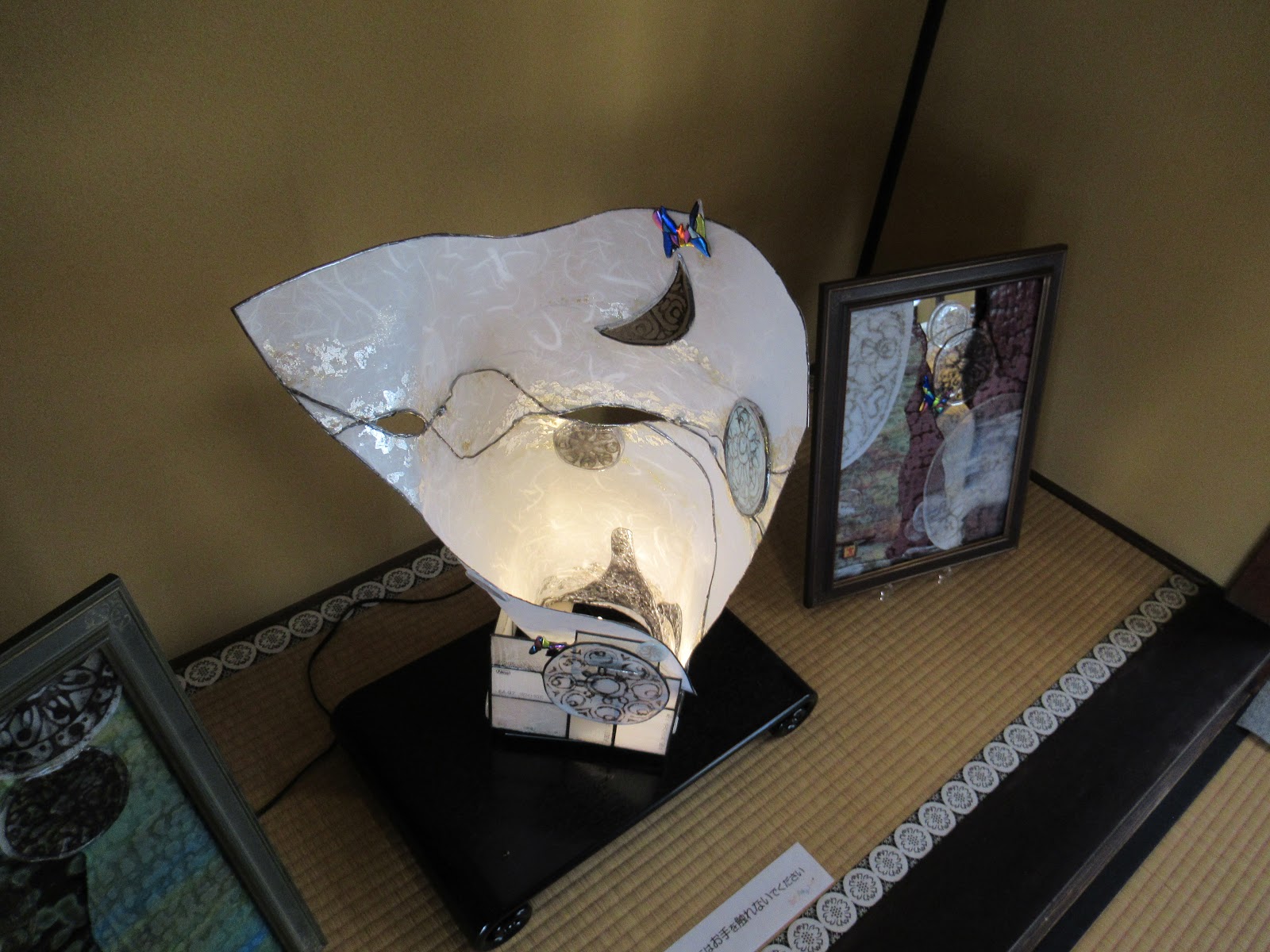
In the museum, they had also an exhibition of stained glass. This one was displayed on the first floor. The combination with Chinese characters was interesting.
The stairs to the second floor were beautiful.
There were more pieces of stained glass on the second floor. I learned that you can used stained glass in many ways.
This one was used for the poster of this exhibition. It was fantastic.
I liked this combination very much. Like Futaba Museum itself, it was a wonderful combination of Western and Japanese cultures.
This time, I walked to the museum from Tokugawaen. But you can take the Nagoya Sightseeing Route Bus “Me-guru”, which may be the easiest way to get there. The website “NAGOYA-INFO” provides various information for tourists.
This museum was one of the admission-free sightseeing spots on October 20. I visited there partly because I like to see stained glass. In the entrance hall, there were big beautiful pieces that welcomed visitors.
When I looked this one, I remembered that Sadayakko herself used to dance and play musical instruments. She was a famous geisha in Tokyo before she married Otojiro Kawakami. With her husband, she toured around the U.S. and Europe and performed brilliantly as an actress.
This is her poster (replica) by a Swiss Painter Alfred Muller for the 1900 Paris Exhibition. She was praised by Rodin, and Picasso painted her performing on the stage.
This kimono is her only stage costume that remains today. It was very big. There was also a replica of a halberd. It is called naginata in Japanese and was often used by women during the Warring States period. I imagined how powerfully she had performed on the stage with this long weapon in her hands.
Sadayakko retired from acting after her husband Otojiro died in 1911. She started to live in this house with her first love, Momosuke Fukuzawa; they met for the first time around 1885 when they were teenagers. Futaba Museum has many tatami rooms with Sadayakko’s belongings displayed. I think she had good taste. For example, I had never seen a hibachi (appliance to warm up the room with charcoal) like this.
This is her shamisen, a musical instrument she used to play.
On the black suitcase, there are initials “M.F.” The brown case on the right has a label “HOTEL (?) CONTINENTAL PARIS.” Maybe it had traveled around Europe with Sadayakko.
These are Sadayakko’s writing desk and cushion.
In the museum, they had also an exhibition of stained glass. This one was displayed on the first floor. The combination with Chinese characters was interesting.
The stairs to the second floor were beautiful.
There were more pieces of stained glass on the second floor. I learned that you can used stained glass in many ways.
This one was used for the poster of this exhibition. It was fantastic.
I liked this combination very much. Like Futaba Museum itself, it was a wonderful combination of Western and Japanese cultures.
This time, I walked to the museum from Tokugawaen. But you can take the Nagoya Sightseeing Route Bus “Me-guru”, which may be the easiest way to get there. The website “NAGOYA-INFO” provides various information for tourists.
Monday, October 21, 2019
Holiday in Nagoya (1) - Tokugawa Garden & Art Museum
Nagoya is the biggest city in Central Japan and the capital of Aichi Prefecture. On a weekend in October, the city has a big event called Nagoya Festival every year with a parade of local historical personages Oda Nobunaga, Toyotomi Hideyoshi, and Tokugawa Ieyasu. All of them were warriors in the Sengoku (Warring States) Period who were from present Aichi Prefecture. Among them, Tokugawa Ieyasu was the one who established the shogunate in Edo (present Tokyo) in 1603. It was the beginning of the Edo Period that lasted until 1868.
I thought it might be interesting to see the parade but didn’t want to be in a crowd. According to the website of the festival, there would be some admission-free sightseeing spots in Nagoya on October 20, the second day of the festival. So, I went there anyway. I took a local train to Toyohashi (the last station) at 8:32 and changed to a special rapid train bound for Ogaki. I got off at Kanayama (in Nagoya), changed to Chuo Main Line bound for Tajimi, and got off at Ozone.
The first destination was Tokugawaen (Tokugawa Garden), which is about 15-minute walk from the station. It is a large Japanese garden whose premises once belonged to the Owari Tokugawa family, a branch of the Tokugawa clan. According to Tokugawaen’s website (also available in English), they were donated to the city in 1931. The present garden was opened in 2004. Its style is that of a daimyo garden constructed by feudal lords during the Edo Period.
When I entered the garden, I was surprised to see a big pond in front of me. As it was one the admission free spots, there were many people strolling in the garden, however, it wasn’t too many. Some of them were feeding carps in the pond. I walked toward the house that was seen beyond the water.
There was a big maple tree whose leaves are turning red. In deep autumn, this tree and the entire garden will surely look beautiful.
In the house, they had a jazz concert. I passed there and came to this stone stairs.
While climbing up the stairs, I saw a water flow.
There was a wooden bridge near the top of the stairs.
The garden was so large that I didn’t really know where to go.
In Tokugawaen, you can forget that you are in a city with population of more than 2.3 million. It is an oasis of the metropolis.
I don’t know their name, but they were pretty.
I enjoyed walking in the garden. It was very refreshing. Beside the garden, there is Tokugawa Art Museum, and I visited there as well (the museum wasn’t admission free).
In the entrance hall, there was an armor
and big map of the present Aichi Prefecture and surrounding areas with old provincial names. As it was based on a drawing in the middle of the Edo period, each area looked distorted. At the lower right of the map, there was Totouminokuni(遠江国)or Enshu, the present western Shizuoka Prefecture, where Hamamatsu is located. The area where Nagoya is located was called Owarinokuni (尾張国). In front of the map, there was a comic foreground of Yoshinao, who was the ninth son of Tokugawa Ieyasu. He was the earliest ancestor of the Owari Tokugawa family and the first feudal lord of the Owari Domain.
In this museum, you can see items used by Tokugawa Ieyasu and members of the Owari Tokugawa family, as well as a noh stage and a tea room. It was prohibited to take pictures in the exhibition rooms, but you can see some exhibits on their website that has also pages in English, Traditional Chinese, Simplified Chinese, and Korean. Personally, I was interested in items for princesses. I heard that they have a special exhibition of their hina dolls in spring every year. It must be splendid to see them.
I got out of the premises from the gate called Kuromon (black gate). It was completed in 1900 as the main gate of the Owari Tokugawa family residence and survived air raids during the World War II. I thought it was miraculous.
I thought it might be interesting to see the parade but didn’t want to be in a crowd. According to the website of the festival, there would be some admission-free sightseeing spots in Nagoya on October 20, the second day of the festival. So, I went there anyway. I took a local train to Toyohashi (the last station) at 8:32 and changed to a special rapid train bound for Ogaki. I got off at Kanayama (in Nagoya), changed to Chuo Main Line bound for Tajimi, and got off at Ozone.
The first destination was Tokugawaen (Tokugawa Garden), which is about 15-minute walk from the station. It is a large Japanese garden whose premises once belonged to the Owari Tokugawa family, a branch of the Tokugawa clan. According to Tokugawaen’s website (also available in English), they were donated to the city in 1931. The present garden was opened in 2004. Its style is that of a daimyo garden constructed by feudal lords during the Edo Period.
When I entered the garden, I was surprised to see a big pond in front of me. As it was one the admission free spots, there were many people strolling in the garden, however, it wasn’t too many. Some of them were feeding carps in the pond. I walked toward the house that was seen beyond the water.
In the house, they had a jazz concert. I passed there and came to this stone stairs.
While climbing up the stairs, I saw a water flow.
There was a wooden bridge near the top of the stairs.
The garden was so large that I didn’t really know where to go.
In Tokugawaen, you can forget that you are in a city with population of more than 2.3 million. It is an oasis of the metropolis.
I don’t know their name, but they were pretty.
I enjoyed walking in the garden. It was very refreshing. Beside the garden, there is Tokugawa Art Museum, and I visited there as well (the museum wasn’t admission free).
In the entrance hall, there was an armor
and big map of the present Aichi Prefecture and surrounding areas with old provincial names. As it was based on a drawing in the middle of the Edo period, each area looked distorted. At the lower right of the map, there was Totouminokuni(遠江国)or Enshu, the present western Shizuoka Prefecture, where Hamamatsu is located. The area where Nagoya is located was called Owarinokuni (尾張国). In front of the map, there was a comic foreground of Yoshinao, who was the ninth son of Tokugawa Ieyasu. He was the earliest ancestor of the Owari Tokugawa family and the first feudal lord of the Owari Domain.
In this museum, you can see items used by Tokugawa Ieyasu and members of the Owari Tokugawa family, as well as a noh stage and a tea room. It was prohibited to take pictures in the exhibition rooms, but you can see some exhibits on their website that has also pages in English, Traditional Chinese, Simplified Chinese, and Korean. Personally, I was interested in items for princesses. I heard that they have a special exhibition of their hina dolls in spring every year. It must be splendid to see them.
I got out of the premises from the gate called Kuromon (black gate). It was completed in 1900 as the main gate of the Owari Tokugawa family residence and survived air raids during the World War II. I thought it was miraculous.
Wednesday, October 16, 2019
Fruits in autumn
Yesterday, I found bags of mandarin oranges sold at a reasonable price. They were of the earliest harvested cultivar from Kumamoto Prefecture. Though they were greenish and looked sour, I bought one bag partly because the label bore the charming mascot character “Kumamon”, which was created to promote public relations for Kumamoto Prefecture and used for many of their products.
This is the first mandarin orange I ate this autumn.
Contrary to my expectation, it wasn’t sour. But it wasn’t particularly sweet, either. Since I was used to eating our local mandarin oranges (Mikkabi brand), which are very sweet, the taste of this one felt too light. However, I think it’s just a matter of liking. There are also people who don’t like mandarin oranges (or fruits in general) that are just sweet.
Personally, I like sweet fruits. With the mandarin oranges, I bought some persimmons. They were ripe and delicious as they were.
This time, I also used one for smoothie with banana and soymilk.
Though the ripe banana might have been very sweet, the smoothie became moderately sweet. I found this combination was very good. However, I still thought it better to eat a persimmon as it is because a ripe persimmon really melts in your mouth!
This is the first mandarin orange I ate this autumn.
Contrary to my expectation, it wasn’t sour. But it wasn’t particularly sweet, either. Since I was used to eating our local mandarin oranges (Mikkabi brand), which are very sweet, the taste of this one felt too light. However, I think it’s just a matter of liking. There are also people who don’t like mandarin oranges (or fruits in general) that are just sweet.
Personally, I like sweet fruits. With the mandarin oranges, I bought some persimmons. They were ripe and delicious as they were.
This time, I also used one for smoothie with banana and soymilk.
Though the ripe banana might have been very sweet, the smoothie became moderately sweet. I found this combination was very good. However, I still thought it better to eat a persimmon as it is because a ripe persimmon really melts in your mouth!
Sunday, October 13, 2019
Hot day after Super Typhoon Hagibis
Super Typhoon Hagibis is gone. In Hamamatsu, it started raining in the evening the day before yesterday. We had heavy rain accompanied with strong wind until yesterday evening, however, the rain weakened after 18:00. I was relieved then though the wind was still blowing violently. While I was watching some films with a headphone, I could take off my mind from it. When I went to bed, I didn’t need to worry about a power outage anymore.
The typhoon made a landfall on the Izu Peninsula in eastern Shizuoka Prefecture around 19:00. Then it moved toward the Kanto area including Tokyo. When I woke up this morning, it was fine. As I was at home all day yesterday, I went out for several hours during the daytime. The sun was shining, and there was no cloud in the sky. The temperature was nearly 30 degrees. It was too hot in the middle of October. The Magome River, whose water level once increased to a dangerous level, seemed normal today. Yesterday, the city sent a message to our cell phones to urge people living near the river to evacuate.
According to the website of NHK (national broadcasting organization), 21 people died, and 16 people are missing (as of 16:41, October 13). There are also 166 people who are injured. I have also learned that in several areas such as Hakone, Ichiyama in Izu, and Kawauchi Village in Fukushima Prefecture, the precipitation of these one to two days was record-breaking and amounted to 30 - 40% of annual precipitation. And enbankments in 21 rivers collapsed in Tohoku and Kanto Districts and Nagano (City). In recent years, there have been too many “record-breaking” disasters. The politicians should take the climate crisis and Greta Thunberg's speech seriously and take concrete measures.
The typhoon made a landfall on the Izu Peninsula in eastern Shizuoka Prefecture around 19:00. Then it moved toward the Kanto area including Tokyo. When I woke up this morning, it was fine. As I was at home all day yesterday, I went out for several hours during the daytime. The sun was shining, and there was no cloud in the sky. The temperature was nearly 30 degrees. It was too hot in the middle of October. The Magome River, whose water level once increased to a dangerous level, seemed normal today. Yesterday, the city sent a message to our cell phones to urge people living near the river to evacuate.
According to the website of NHK (national broadcasting organization), 21 people died, and 16 people are missing (as of 16:41, October 13). There are also 166 people who are injured. I have also learned that in several areas such as Hakone, Ichiyama in Izu, and Kawauchi Village in Fukushima Prefecture, the precipitation of these one to two days was record-breaking and amounted to 30 - 40% of annual precipitation. And enbankments in 21 rivers collapsed in Tohoku and Kanto Districts and Nagano (City). In recent years, there have been too many “record-breaking” disasters. The politicians should take the climate crisis and Greta Thunberg's speech seriously and take concrete measures.
Friday, October 11, 2019
Super typhoon is coming
Last year, people in Shizuoka Prefecture experienced a strong typhoon that caused a power outage for more than 780,000 households. It was at the end of September, and I was traveling in Sweden. When I came home at the beginning of October, the neighborhood I live in had already recovered from the power outage. But it took seven days for the entire area of Hamamatsu to recover completely.
Last month, Chiba Prefecture was hit by a severe typhoon. The recovery is still ongoing, however; another typhoon is coming. It is Super Typhoon Hagibis, which is known as Typhoon #19 in Japan. It is expected to make landfall on the main island Honshu tomorrow, causing heavy rain especially in Central Japan and Kanto District including Tokyo. Because of this typhoon, all Shinkansen service from Tokyo to Nagoya will be canceled on October 12.
As this is my first time to experience a super typhoon, I have been nervous these days. Yesterday, I bought a pack of 8 dry cells for my flashlight. I heard that my parents had used a candle during the power outage last year, but it is much safer to use a flashlight.
On the Internet, there were websites that give tips about how to prepare for a typhoon. I have bought three packs of rye bread in the basement of the JR Hamamatsu Station building, three 2-liter bottles of water, bananas, and apples in case that tap water and gas won’t be available (since packs of rye bread lasts for several months, they are also convenient to keep as emergency food for an earthquake). I have taken the flowerpots and the wash-line pole on the balcony into the room so that they wouldn’t break or move to somewhere. It is also necessary to fill the bathtub to keep water for the sink and the toilet. But I can do it tomorrow. I will stay at home all day as it may be almost impossible to go out.
Last month, Chiba Prefecture was hit by a severe typhoon. The recovery is still ongoing, however; another typhoon is coming. It is Super Typhoon Hagibis, which is known as Typhoon #19 in Japan. It is expected to make landfall on the main island Honshu tomorrow, causing heavy rain especially in Central Japan and Kanto District including Tokyo. Because of this typhoon, all Shinkansen service from Tokyo to Nagoya will be canceled on October 12.
As this is my first time to experience a super typhoon, I have been nervous these days. Yesterday, I bought a pack of 8 dry cells for my flashlight. I heard that my parents had used a candle during the power outage last year, but it is much safer to use a flashlight.
On the Internet, there were websites that give tips about how to prepare for a typhoon. I have bought three packs of rye bread in the basement of the JR Hamamatsu Station building, three 2-liter bottles of water, bananas, and apples in case that tap water and gas won’t be available (since packs of rye bread lasts for several months, they are also convenient to keep as emergency food for an earthquake). I have taken the flowerpots and the wash-line pole on the balcony into the room so that they wouldn’t break or move to somewhere. It is also necessary to fill the bathtub to keep water for the sink and the toilet. But I can do it tomorrow. I will stay at home all day as it may be almost impossible to go out.
Wednesday, October 9, 2019
Spaghetti with vegan Pesto Genovese sauce
In May, I introduced Itsukiya Honpo that sells tofu pickled in miso in this blog. Last month, they had a temporary shop in the basement of Entetsu Department Store again, so I bought some products including two new items.
According to the labels, they are called “Tofu miso pickled in olive oil” and “Tofu miso pickled in genovese” respectively. They looked like this. Both of them contained tofu cheese or tofu pickled in miso, which had been further pickled in olive oil and basil sauce respectively.
According to the salesclerk, you can use these products very easily. For example, you can just pour one half of the contents of the one with basil sauce onto spaghetti. So, I did it this evening for dinner by using gluten free spaghetti of alce nero. It was made from organic corn and rice. In Japan, gluten free spaghetti and pasta are often made from rice or brown rice, however, it is difficult to find products without food additives. So, I chose a product imported from Italy. Though gluten free spaghetti is very expensive compared with products made from wheat flour, I just felt like trying it, expecting that it might be better for the health.
After boiling 80g of it for 10 minutes and drained water, I poured “Tofu miso pickled in genovese.” Spaghetti had a light yellow color that matched the sauce.
Since I have been trying to be a vegan, I had given up buying ordinary Pesto Genovese sauce home as it contains not only basil and pine nuts but also cheese. So, I was very glad to find that this vegan sauce tasted as good as such Pesto Genovese sauce. It was understandable because tofu pickled with miso is a fermented food like cheese. It has a rich flavor. Unlike Pesto Genovese sauce, it didn’t contain pine nuts, however, it contained extra virgin olive oil, basil, dried garlic, black pepper and so on.
I have also tried another product “Tofu miso pickled in olive oil.” I used it for salad with spinach and parsley.
These cubes reminded me of cubic cheese in oil from Denmark, which had been also my favorite (I had given it up, too). I found this vegan cubes quite good. In addition, I had smoked tofu cheese to spread on rye bread. It has a distinctive smoky flavor like smoked cheese, and I liked it very much.
I wish these kinds of products will be always available in ordinary supermarkets all over Japan. Then, it will be much easier to become a vegan.
According to the labels, they are called “Tofu miso pickled in olive oil” and “Tofu miso pickled in genovese” respectively. They looked like this. Both of them contained tofu cheese or tofu pickled in miso, which had been further pickled in olive oil and basil sauce respectively.
According to the salesclerk, you can use these products very easily. For example, you can just pour one half of the contents of the one with basil sauce onto spaghetti. So, I did it this evening for dinner by using gluten free spaghetti of alce nero. It was made from organic corn and rice. In Japan, gluten free spaghetti and pasta are often made from rice or brown rice, however, it is difficult to find products without food additives. So, I chose a product imported from Italy. Though gluten free spaghetti is very expensive compared with products made from wheat flour, I just felt like trying it, expecting that it might be better for the health.
After boiling 80g of it for 10 minutes and drained water, I poured “Tofu miso pickled in genovese.” Spaghetti had a light yellow color that matched the sauce.
Since I have been trying to be a vegan, I had given up buying ordinary Pesto Genovese sauce home as it contains not only basil and pine nuts but also cheese. So, I was very glad to find that this vegan sauce tasted as good as such Pesto Genovese sauce. It was understandable because tofu pickled with miso is a fermented food like cheese. It has a rich flavor. Unlike Pesto Genovese sauce, it didn’t contain pine nuts, however, it contained extra virgin olive oil, basil, dried garlic, black pepper and so on.
These cubes reminded me of cubic cheese in oil from Denmark, which had been also my favorite (I had given it up, too). I found this vegan cubes quite good. In addition, I had smoked tofu cheese to spread on rye bread. It has a distinctive smoky flavor like smoked cheese, and I liked it very much.
I wish these kinds of products will be always available in ordinary supermarkets all over Japan. Then, it will be much easier to become a vegan.
Subscribe to:
Posts (Atom)
Happy New Year of Ox 2021
If you are in Japan during the year-end and New Year holidays, you can see many pretty sweets at Japanese confectionary stores. As 2021 is t...
-
In Japan, vegetarians or vegans may sometimes feel themselves unwelcome in restaurants, because it is very difficult to find substantial dis...
-
Several months ago, I read about vegan noodle “Shin Ramen (Shin Ramyeon/Shin Ramyun)” made by a food company Nongshim in Korea on the Intern...
-
Last Saturday, I visited Create Hamamatsu, a community center near Enshu Byoin Station of Enshu Railway Line. They had Winter Festival with ...